Salesforce for real estate: lead-to-booking CRM for a residential developer
Residential developers get leads from property portals, ads, walk-ins and brokers, and lose track of many before the site visit. This is how we'd set up Salesforce to carry each buyer from enquiry to booking, with live unit inventory and a portal for channel partners.
Industry
Real estate
Typical timeline
12–14 weeks
Typical team
5 people

The situation
Picture a residential developer in Pune with three projects selling at once: mid-segment towers in Hinjawadi and Wakad and a premium project in Baner. It spends heavily on property portals and social ads, works with around 200 channel partners, and runs a pre-sales call team and site-office sales teams.
Leads arrive from six or seven sources into a mix of portal dashboards, email and a lead management tool that nobody fully trusts. The same buyer often appears three times. Some leads aren't called for a day, by which time they've visited a competitor. Unit availability lives in an Excel sheet that the CRM head updates twice a day, so salespeople occasionally offer a unit that was booked that morning. Brokers argue about who brought a buyer, and the finance team re-keys every booking into the ERP.
The developer needs one system from first enquiry to booking: every lead captured and called quickly, every site visit tracked, inventory that's always live, partner credit decided by rules rather than arguments, and a clean hand-off to the ERP once a buyer books.
Signs this blueprint fits you
- You can't say with confidence which lead source produced last month's bookings.
- Lead response time is measured in hours, not minutes.
- Inventory and pricing live in spreadsheets.
- Channel partner disputes over credit are a regular event.
What we'd build
- Lead capture from every source: portal APIs or parsed emails, ad lead forms, website forms, IVR and walk-in registration, all landing in Sales Cloud with the source recorded.
- De-duplication and partner credit rules that keep one record per buyer and decide credit by agreed rules, such as first registration within a validity window.
- Fast routing and follow-up: instant WhatsApp reply with the brochure, round-robin assignment to pre-sales, click-to-call and follow-up tasks.
- Site visit management: booking, reminders, check-in at the site office and feedback captured on a tablet.
- Live unit inventory by project, tower, floor and unit, with price, status and time-limited holds.
- Bookings with booking amount, KYC documents and agreement milestones, and an integration that creates the customer in the ERP.
- A channel partner portal where brokers register buyers, see status and track their commission.

How the pieces fit
One buyer, many touchpoints
Matching on phone number and email, with fuzzy matching on names, keeps one record per buyer even when they enquire on two portals and come through a broker. Each touch is kept as a campaign response, so marketing sees every source that played a part and sales sees one person.
Speed to lead
In residential sales, the first developer to call often gets the visit. New leads trigger an instant WhatsApp message and land in a pre-sales queue. If nobody calls within the agreed time, the lead is reassigned and the manager is alerted.
Inventory that can't be double-sold
Units are records with a status: available, on hold, booked, registered. A hold reserves a unit for a set time and then releases it automatically. Booking a unit locks it. Price changes are versioned, so every quote can be traced to the price list in force that day.
Hand-off to finance
When the booking amount is received and KYC is complete, the customer and unit details go to the ERP, such as Farvision or SAP, where demand letters and the customer ledger are managed. Salesforce shows payment milestones back to sales so they can answer buyer questions.
One buyer, end to end
Here is a couple's journey from a portal enquiry to a booking, including a duplicate from a broker.

What the sales manager would see
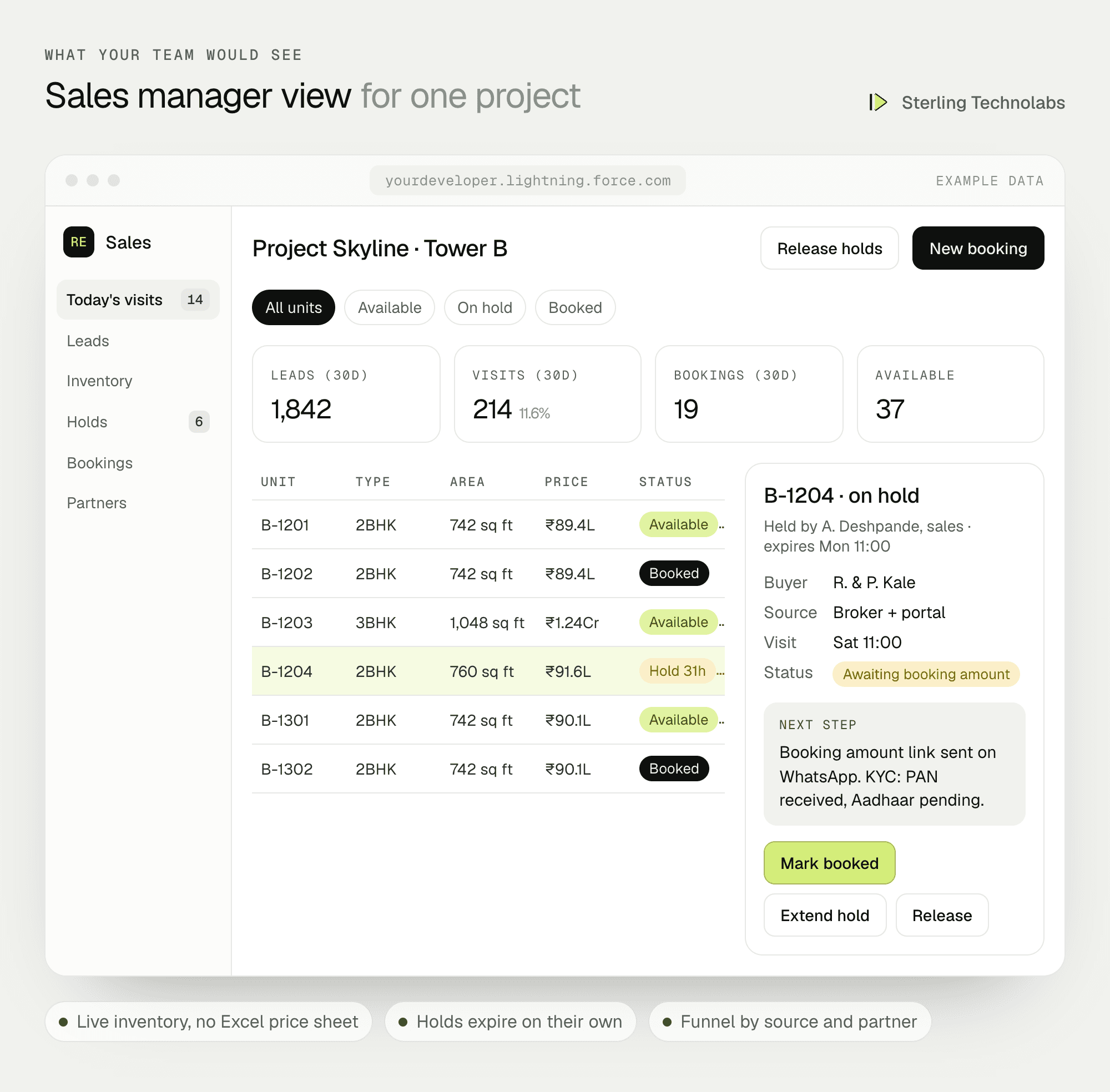
Managers see their project as it is right now: today's visits, live inventory, holds about to expire and bookings this month. The funnel from leads to visits to bookings is split by source and partner, so spend decisions are based on bookings rather than lead counts.
Data and integrations
| System | What flows | Direction | How we connect |
|---|---|---|---|
| Property portals | New enquiries | Portal to Salesforce | Portal APIs where available, otherwise parsed lead emails |
| Meta and Google ads | Lead form submissions | Ads to Salesforce | Native lead sync or webhook |
| Cloud telephony (Exotel, Knowlarity) | Click-to-call, call logs, recordings | Both ways | Telephony API and CTI |
| WhatsApp Business | Brochures, visit reminders, replies | Both ways | Approved BSP |
| ERP (Farvision, SAP) | Booked customer, unit, price | Salesforce to ERP | API or staging table |
| Payment gateway | Booking amount status | Gateway to Salesforce | Payment link with webhook |
Delivery plan

The pilot runs on one live project so that sales, pre-sales and the CRM team can test the full journey with real buyers. Daily stand-ups during the pilot catch friction early, such as a field nobody fills in or a step that slows down a booking. Other projects follow once the pilot team is comfortable.
The team
| Role | Time | What they own |
|---|---|---|
| Salesforce solution architect | Part time | Data model, inventory design, sharing, integrations |
| Business analyst | Weeks 1–12 | Workshops with sales, pre-sales, CRM and finance |
| Salesforce developers (2) | Full time | Lead flows, inventory, bookings, partner portal |
| Integration developer | Weeks 3–10 | Portals, telephony, WhatsApp, ERP, payments |
From your side: the head of sales, the CRM head, a finance contact for the ERP hand-off, and two or three channel partners to test the portal.
What changes the effort
- Number of projects and inventory complexity. Plotted developments, villas and commercial units each need their own inventory model.
- Portal integrations. APIs are quick; parsing lead emails from portals without APIs takes testing per portal.
- Pricing rules. Floor rise, view premiums, payment-plan discounts and offers add pricing logic.
- Post-booking scope. Demand letters, construction-linked payments and possession handover are a further phase.
- Data migration. Moving existing leads and bookings from another CRM adds clean-up work.
Risks and how we'd handle them
| Risk | What we'd do |
|---|---|
| Sales teams keep using WhatsApp and Excel | Make the CRM the fastest way to do their job: click-to-call, WhatsApp from the record, mobile site-visit check-in. |
| Double-selling a unit | Unit status locked on hold and booking, with automatic hold expiry and an audit trail of every change. |
| Partner disputes | Credit rules agreed and written down in week one, applied automatically, and visible to partners in their portal. |
| Bad source data from portals | Validation on capture, phone normalisation, and a review queue for incomplete leads. |
| Finance mismatch | ERP is the record for money; Salesforce shows milestones read from it rather than calculating them. |
What we'd measure
| Metric | How we'd measure it | Baseline from |
|---|---|---|
| Speed to lead | Lead created to first call connected | Sample from current tool |
| Lead to site visit | Share of leads with a completed visit, by source | Current visit register |
| Visit to booking | Share of visits that book within 30 days | Current booking register |
| Cost per booking by source | Spend per source divided by bookings credited | Marketing spend and bookings |
| Inventory errors | Units offered while unavailable | Sales team estimate |
Build or buy?
There are real estate CRMs built for Indian developers, and for a single-project developer one may be enough. Salesforce makes sense when you run several projects, want marketing, sales and partner management on one platform, need integrations with your own ERP and telephony, and want reports you can shape yourself. It also scales with you if you add commercial projects, leasing or after-sales service later.
Questions we'd ask on the first call
- How many projects are selling now, and how many launches are planned?
- Which lead sources matter most, and how do leads reach your team today?
- How do you decide which channel partner gets credit for a buyer?
- Where does inventory and pricing live, and who updates it?
- Which ERP handles bookings and customer ledgers?
FAQ
Can salespeople use it on their phones?
Yes. The Salesforce mobile app covers leads, calls, visits and inventory, and site-visit check-in works well on a tablet at the site office.
Can we handle RERA details?
Project RERA numbers, carpet areas and approved plans can be stored on project and unit records and included in brochures and quotes.
What about after possession?
Possession handover, snag lists and maintenance requests fit well in Service Cloud as a later phase on the same platform.
:: Typical stack
Sales Cloud, Experience Cloud for channel partners, Flow, WhatsApp Business API, payment gateway, ERP integration
:: Related service
Salesforce Sales Cloud
See the service

Send us your brief. We’ll help turn it into reality
A senior engineer replies within one business day with questions or a first plan: approach, team, timeline and estimate.
More blueprints like this


