Salesforce for an independent insurance agency
Insurance agencies run policies well in their agency management system and almost everything else in spreadsheets and inboxes. This is how we'd set up Salesforce beside the AMS for renewals, cross-sell, service requests and producer pipeline.
Industry
Insurance brokerage
Typical timeline
12–16 weeks
Typical team
5 people

The situation
Picture an independent insurance agency with 12 offices across Pennsylvania and Ohio, 45 producers and 70 account managers. It writes commercial lines for contractors, manufacturers and transport companies, plus personal lines for business owners and their families. Policies, endorsements and commissions live in its agency management system, Applied Epic, which works well for that job.
Everything else is scattered. Producers keep prospects in their own spreadsheets. Renewals are noticed 30 days out instead of 120, so remarketing is rushed. Cross-sell is accidental: a commercial client's owner has home and auto elsewhere and nobody knows. Certificate of insurance requests and endorsement changes arrive by email to whoever the client knows, and the agency can't say how quickly service requests are handled. Leadership has no view of pipeline across offices.
The agency wants a CRM for insurance that sits alongside Applied Epic, not instead of it: one place for prospects, renewals, cross-sell, service requests and marketing.
Signs this blueprint fits you
- Your agency management system handles policies well but not sales or service.
- Producers track prospects in spreadsheets or their inbox.
- Renewals are worked weeks too late to remarket properly.
- Certificate and endorsement requests arrive by email with no tracking.
- Leadership can't see pipeline, retention or cross-sell across offices.
What we'd build
- Salesforce Financial Services Cloud configured for an agency: households and businesses, contacts, relationships between them, and policies synced from the AMS.
- New business pipeline for commercial and personal lines, with stages from prospect to bound, by producer and office.
- A renewal desk that opens every renewal 120 days out, assigns remarketing tasks by premium and risk, and tracks quotes from carriers.
- Cross-sell and account rounding: a view of each client's coverage across lines, with gaps flagged, such as a business owner with no umbrella or personal lines with the agency.
- Service cases for certificate of insurance requests, endorsements, claims help and billing questions, with web forms, email-to-case and response targets.
- Producer and leadership dashboards: pipeline, renewal retention, cross-sell ratio, service response times.
- Marketing journeys for renewal reminders, cross-sell campaigns and new-client onboarding.
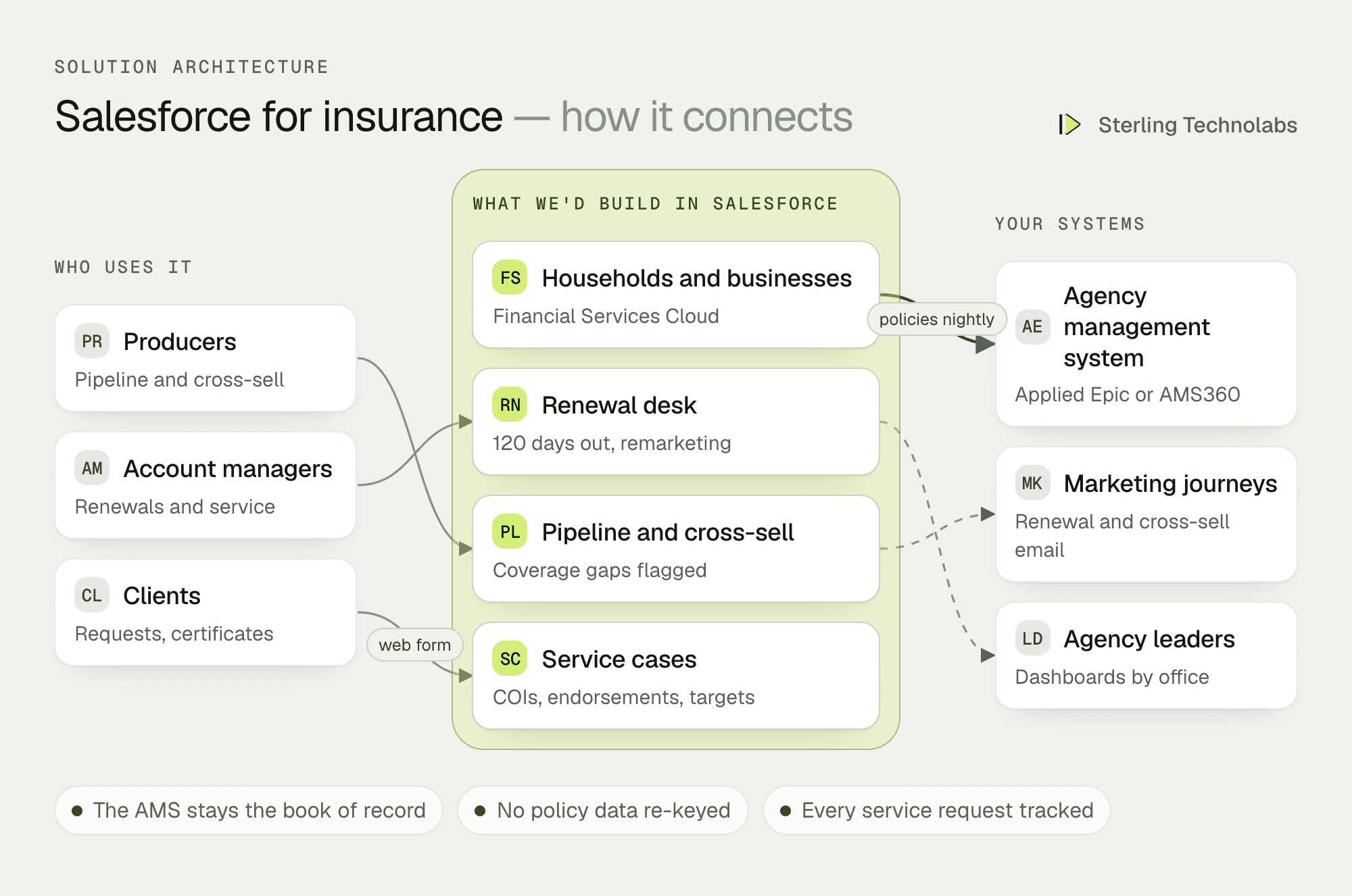
How the pieces fit
The AMS stays the book of record
Applied Epic (or Vertafore AMS360, or another AMS) remains the system for policies, endorsements, billing and commissions. Salesforce reads clients, policies, lines, premiums and expiration dates from it every night through the AMS's API, so producers and account managers see the full book without double entry. When a deal is bound, the account manager completes it in the AMS as today.
Financial Services Cloud for insurance
Financial Services Cloud provides a data model built for insurance and financial relationships: households, businesses, people with several roles, and policies attached to each. That is what makes account rounding work, because a business owner, their company and their family are linked, and gaps across commercial and personal lines become visible.
Renewals worked early
Every policy approaching expiration creates a renewal opportunity 120 days out. Large or high-risk accounts get a remarketing plan with tasks and carrier quote tracking; small, stable accounts get a lighter check. Account managers see their renewals by month and status instead of finding them in an expiration report.
Service with a clock on it
Service requests become cases with types, owners and response targets. Certificate of insurance requests can come through a web form, and simple ones can be prepared from AMS data for an account manager to review and send. Every case is visible to the whole team, so nothing is stuck in one person's inbox.
One renewal, end to end
Here is a commercial package renewal for a contracting business, worked from 120 days out to bound, with a cross-sell along the way.

The renewal was remarketed with time to spare, and the agency found the owner's personal lines gap because the business and the family were linked in one record.
What producers and account managers would see
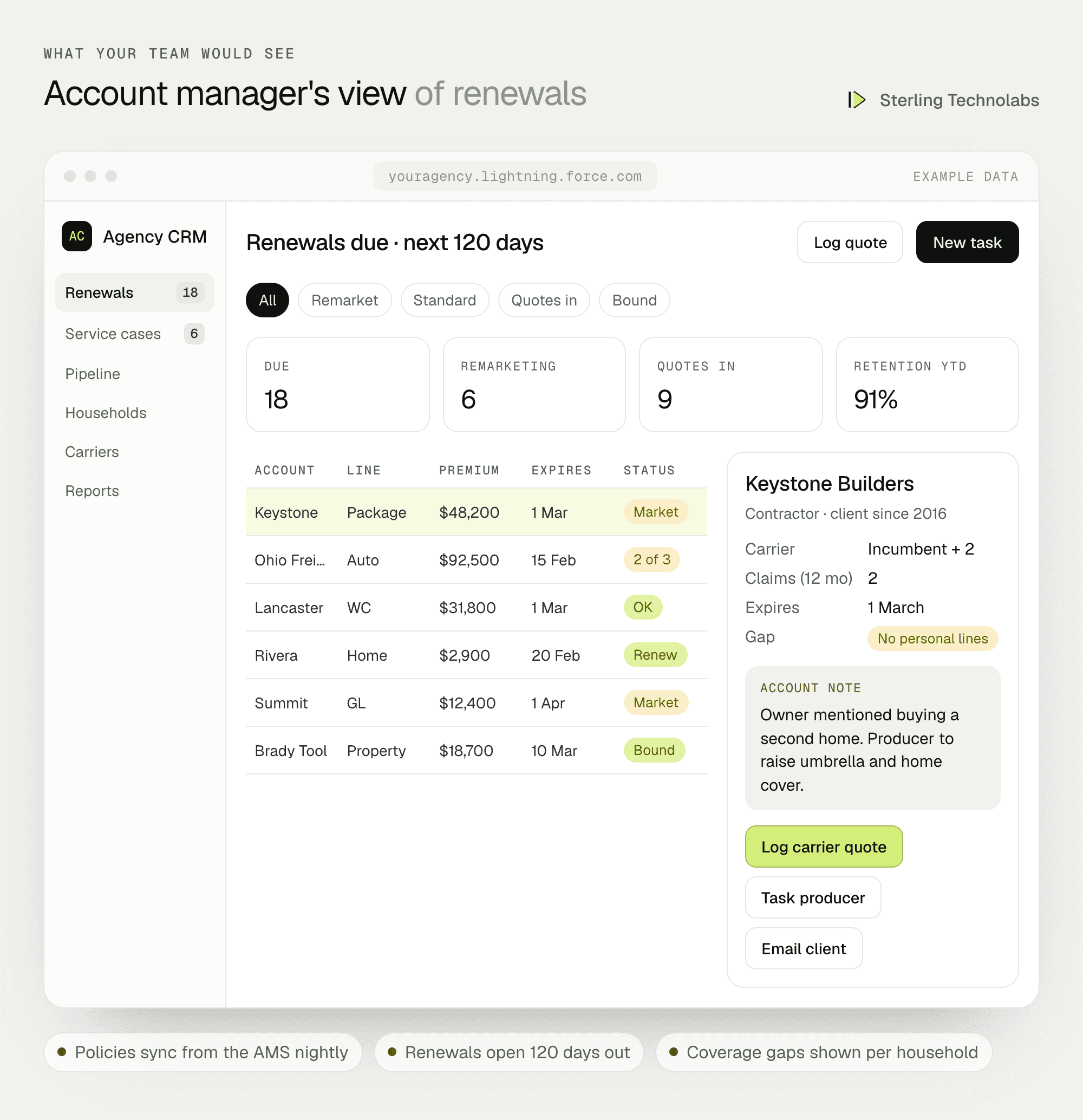
Account managers start from renewals due by month, with premium, carrier, risk and remarketing status. Producers see their pipeline and the cross-sell gaps in their book. Leaders see the same by office.
Salesforce for insurance agents: features by role
| Producers | Account managers | Agency leaders |
|---|---|---|
| New business pipeline | Renewal desk 120 days out | Pipeline by office and line |
| Cross-sell gaps in their book | Service cases with targets | Renewal retention |
| Prospect lists and activity | Certificate requests | Cross-sell ratio |
| Mobile app for visits | Carrier quote tracking | Service response times |
Data and integrations
| Data | System of record | Direction | When |
|---|---|---|---|
| Clients, contacts | AMS | AMS to Salesforce, new prospects created in Salesforce | Nightly |
| Policies, lines, premiums, expirations | AMS | AMS to Salesforce | Nightly |
| Prospects and new business | Salesforce | Salesforce only until bound | Not applicable |
| Service cases | Salesforce | Notes added to AMS activity (optional) | On close |
| Marketing consent and engagement | Salesforce | Salesforce only | Not applicable |
| Commissions | AMS | AMS to Salesforce, for dashboards | Monthly |
Delivery plan
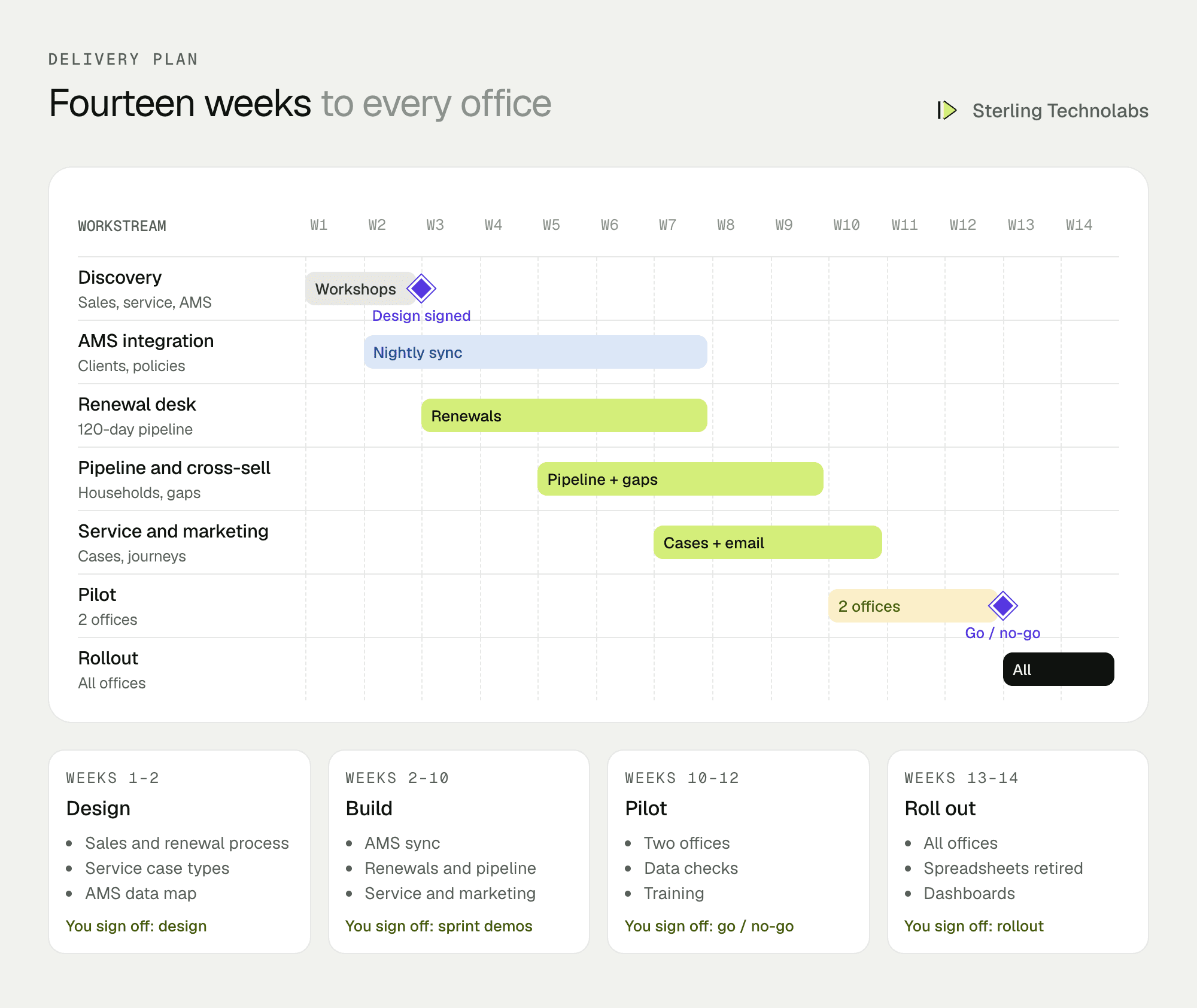
We'd start with the AMS integration and the renewal desk, because that's where the agency gains most quickly and it fills Salesforce with real data. Pipeline, cross-sell and service follow, then marketing. Two offices pilot before the rest of the agency moves over.
The team
| Role | Time | What they own |
|---|---|---|
| Salesforce solution architect | Part time | Data model, AMS integration, security |
| Business analyst with agency experience | Full time | Renewal, service and sales processes, UAT |
| Salesforce developers (2) | Full time | Configuration, flows, components, dashboards |
| Integration developer | Weeks 2–9 | AMS API, nightly sync, monitoring |
| QA engineer | Weeks 7–14 | Data checks, UAT support |
From your side: a sales leader, a service or operations lead, your AMS administrator, and two or three producers and account managers.
What changes the effort
- AMS. Applied Epic and AMS360 have APIs; older systems may need file-based exports.
- Lines of business. Commercial and personal lines together need more relationship modelling than one alone.
- Benefits. Employee benefits brokerage has its own sales cycle and data and is often a second phase.
- Marketing. Simple email journeys are quick; full marketing automation is a phase of its own.
- Data clean-up. Duplicate clients and inconsistent names in the AMS need fixing before the first sync.
Risks and how we'd handle them
| Risk | What we'd do |
|---|---|
| Double entry | Policies and clients come from the AMS automatically; nobody re-keys policy data into Salesforce. |
| Producers don't use it | Producers help design the pipeline and mobile view, and spreadsheets are retired on a set date. |
| Bad data from the AMS | Duplicate and data quality report before the first load, cleaned with your account managers. |
| Licence cost | We match licence types to roles in the design phase, so not everyone needs a full Financial Services Cloud seat. |
| Privacy and consent | Consent captured per contact and channel, and marketing only to people who agreed. |
What we'd measure
| Metric | How we'd measure it | Baseline from |
|---|---|---|
| Renewal retention | Policies renewed as a share of those due | AMS reports |
| Days worked before renewal | Days between first renewal task and expiration | Current expiration reports |
| Policies per client | Average lines per household or business | AMS book data |
| Service response time | Case opened to first response, by type | Not measured today |
| New business pipeline | Open premium by stage and office | Producer spreadsheets |
Build or buy?
Several CRMs are built only for insurance agencies, and for a small agency one of them may be simpler. Salesforce fits agencies that want one platform for sales, service and marketing across many offices, need to model complex commercial relationships, plan to grow through acquisition, or already use Salesforce in another part of the business. We'd tell you on the first call if a lighter insurance CRM is the better fit.
Questions we'd ask on the first call
- Which agency management system do you use, and what does it handle well?
- How many producers, account managers and offices?
- How do you work renewals today, and how far ahead?
- How do service requests and certificate requests come in?
- What would leadership like to see every Monday that it can't see now?
FAQ
Is Salesforce good for insurance agencies?
Yes, for agencies that want sales, service and marketing on one platform alongside their agency management system. Financial Services Cloud adds a data model built for insurance relationships.
Does Salesforce replace Applied Epic or AMS360?
No. The AMS stays the system of record for policies, billing and commissions. Salesforce reads from it and handles sales, renewals, cross-sell and service.
Can Salesforce handle certificate of insurance requests?
Yes. Requests become tracked cases from a web form or email, and simple certificates can be prepared from AMS data for an account manager to review and send.
How long does a Salesforce implementation for an insurance agency take?
A first phase with AMS integration, renewals, pipeline, cross-sell and service typically takes 12 to 16 weeks including a pilot.
:: Typical stack
Salesforce Financial Services Cloud, Service Cloud, Flow, Marketing journeys, Applied Epic or AMS360 integration
:: Related service
Salesforce implementation
See the service

Send us your brief. We’ll help turn it into reality
A senior engineer replies within one business day with questions or a first plan: approach, team, timeline and estimate.
More blueprints like this


