Salesforce Field Service for a commercial HVAC contractor
HVAC contractors lose money to whiteboard dispatch, missed maintenance visits and second trips for parts. This is how we'd implement Salesforce Field Service so the right technician arrives with the right part, and the job is invoiced the same day.
Industry
HVAC and building services
Typical timeline
14–16 weeks
Typical team
5 people

The situation
Picture a commercial and residential HVAC contractor in Texas with 140 technicians across Dallas, Houston and Austin. About half its revenue comes from maintenance agreements with offices, schools and restaurants; the rest from repairs, emergency calls and replacements. Summer heat brings hundreds of no-cool calls a day.
Dispatch runs on a whiteboard, a scheduling tool that doesn't know technicians' skills, and a lot of phone calls. Maintenance visits are scheduled from a spreadsheet and sometimes missed, which puts contract renewals at risk. Technicians drive to a job without the right part because nobody knows what's on each van. Quotes for repairs are written on paper and approved days later. Invoices go out a week after the work.
The company already uses Salesforce for sales. It wants HVAC field service management on the same platform: Salesforce Field Service for scheduling, dispatch, the technician app, maintenance plans and van stock, connected to its accounting system.
Signs this blueprint fits you
- You run more than 40 technicians and dispatch by phone and whiteboard.
- Maintenance agreements are scheduled by hand and visits get missed.
- Technicians often lack the right part or skill for the job.
- Quotes and invoices are slow because they start on paper.
- You already use Salesforce, or want sales and service on one platform.
What we'd build
- Work orders and service appointments for repairs, maintenance, emergency calls and installs, created from calls, the customer portal, email or sales opportunities.
- Scheduling and dispatch using Salesforce Field Service scheduling: skills (commercial refrigeration, controls, EPA certification), territories, travel time, priorities and service windows, with a dispatcher console for exceptions.
- The Field Service mobile app for technicians: job details, equipment history, checklists, photos, parts used, on-site quotes, customer signature and payment, working offline in basements and plant rooms.
- Maintenance plans that generate visits automatically for every agreement, by asset and frequency.
- Van and warehouse inventory: parts on each van, transfers, and reorder requests when stock runs low.
- A customer portal where commercial clients see equipment, visit history, open quotes and invoices.
- Accounting integration so completed work becomes an invoice the same day.
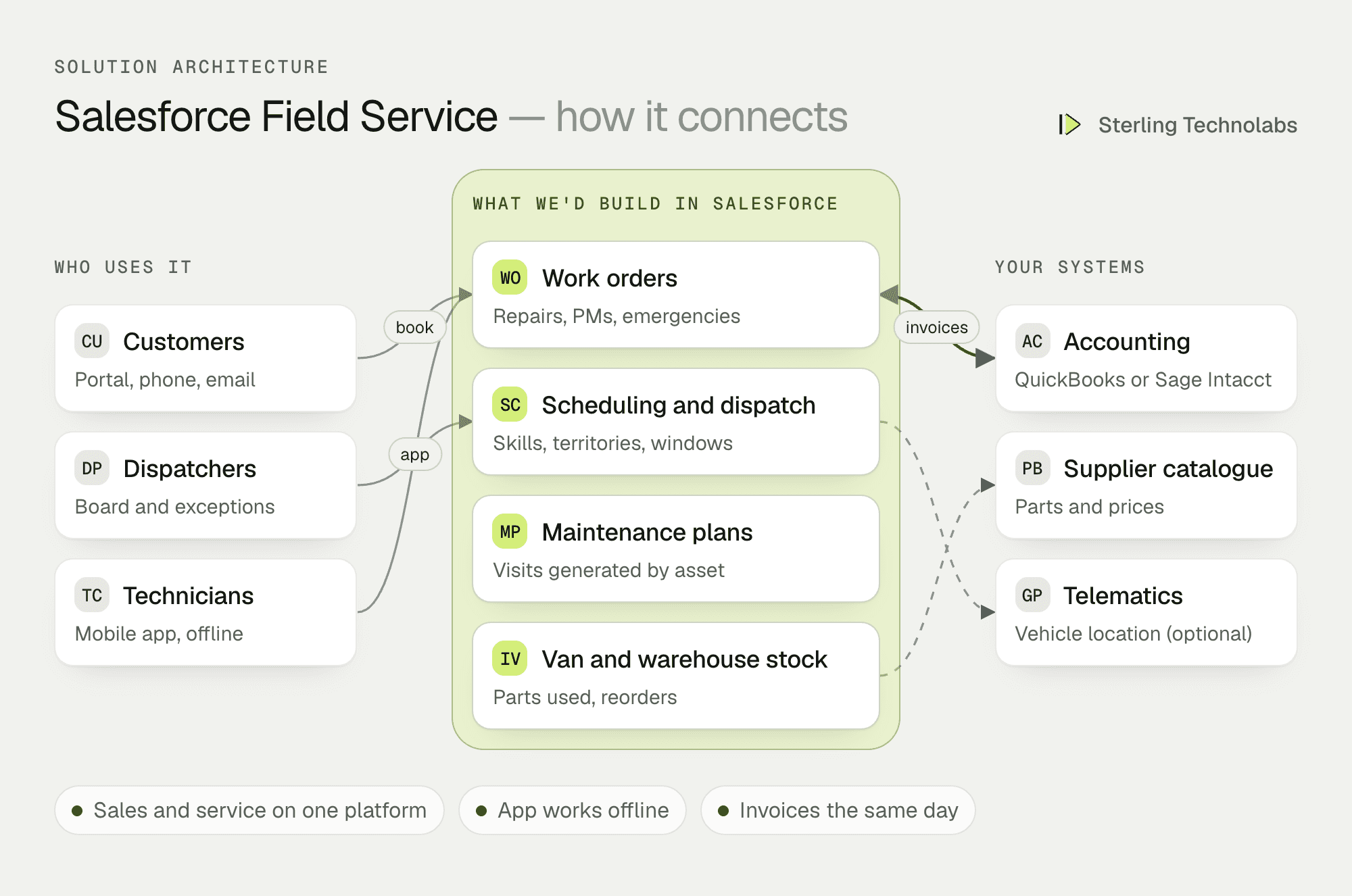
How the pieces fit
One record for sales and service
Customers, sites and equipment already live in Salesforce from sales. Field Service adds work orders, service appointments, technicians (service resources), territories, skills and maintenance plans on top. A rooftop unit installed by the sales team becomes an asset with a maintenance plan, and every visit, part and photo builds its history.
Scheduling that knows the job
Scheduling policies weigh what matters to the business: emergency calls first, then contract customers inside their service window, then repairs. The scheduler only offers technicians with the right skills and certifications, and considers travel time between jobs. Dispatchers watch the Gantt view and step in when a job runs long or a technician calls in sick.
The technician's day
Technicians see their route for the day in the Field Service mobile app. On site, they see the unit's history, run the maintenance checklist, log parts from their van, take photos and, if they find a problem, build a quote with prices from the price book. The customer approves and signs on the phone, and payment can be taken on the spot for residential jobs.
Accounting stays where it is
QuickBooks, Sage Intacct or another accounting system remains the record for invoices and payments. Completed work orders flow across with labour, parts and approved quotes, so invoices go out the same day instead of after a week of paperwork.
One service call, end to end
Here is a no-cool call from a restaurant on a 100-degree afternoon.
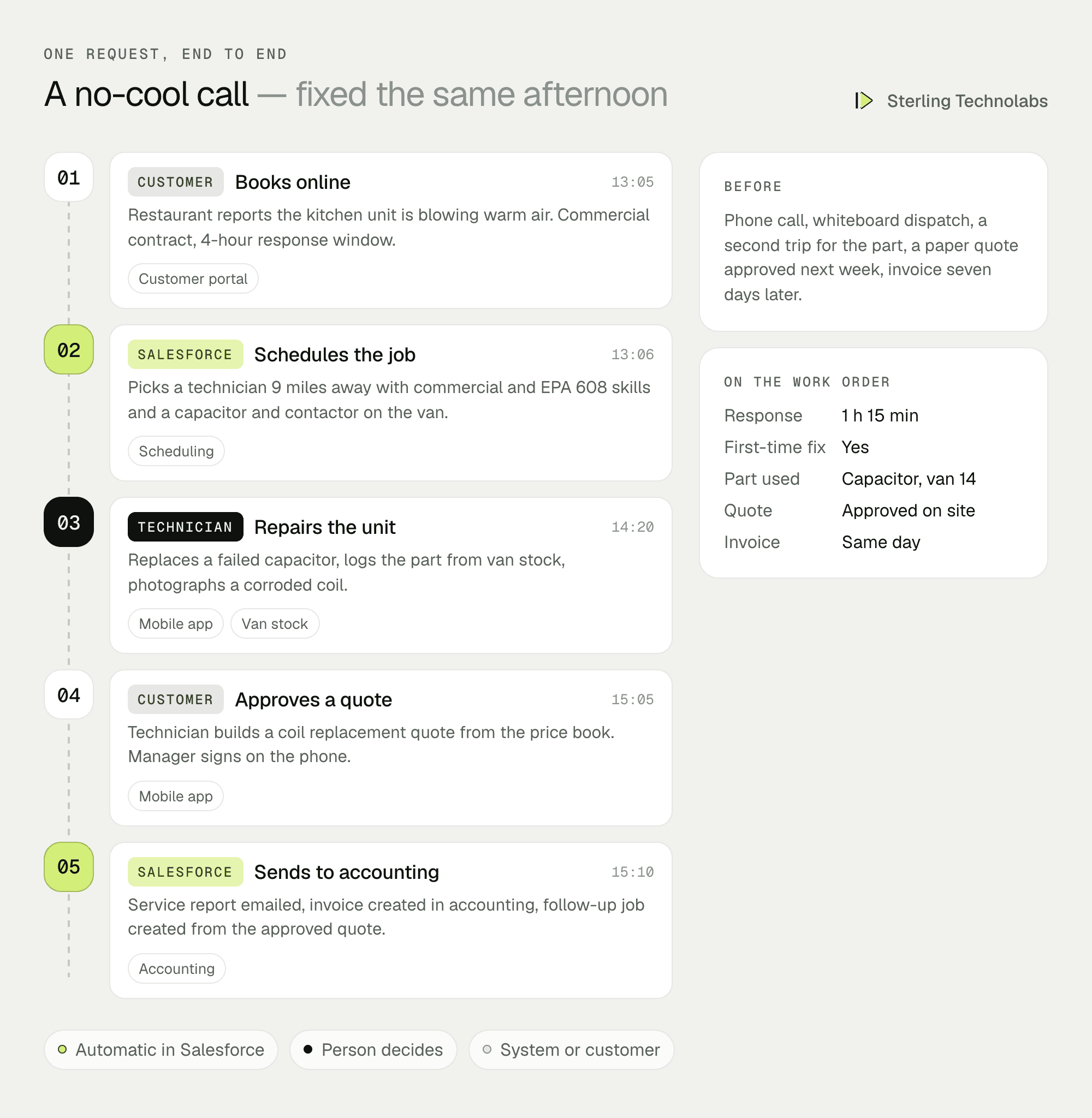
The call was booked, dispatched to the nearest qualified technician with the right part on the van, fixed, quoted, approved and invoiced in one afternoon.
What dispatchers and technicians would see
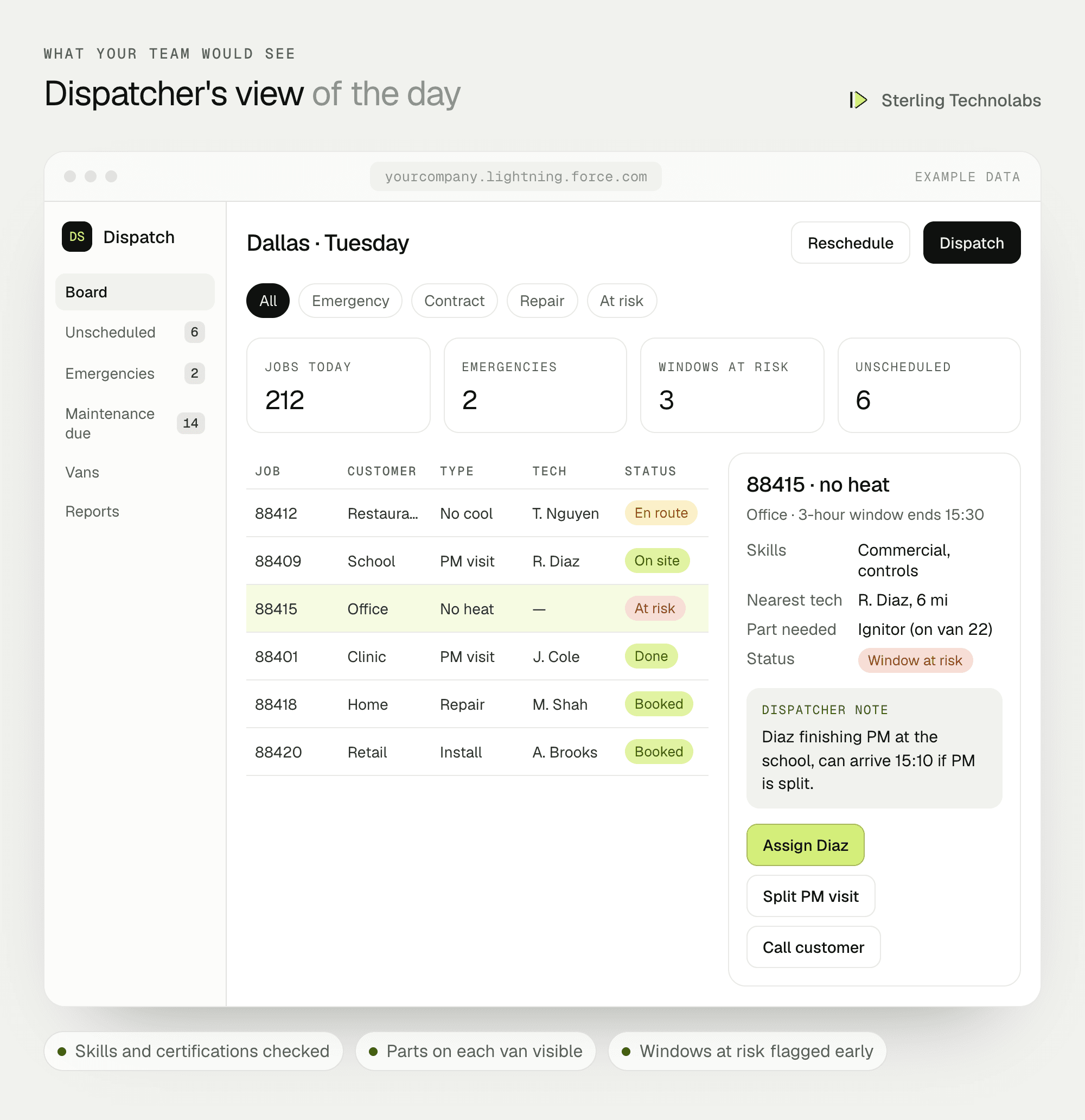
Dispatchers see every technician's day on one board, with emergency calls and service windows at risk highlighted. Technicians see the same jobs as a route on their phone.
HVAC field service features by role
| Technicians | Dispatchers and service managers | Customers |
|---|---|---|
| Daily route and job details | Scheduling and dispatch board | Book service online |
| Equipment history and checklists | Maintenance plans and visit due dates | Arrival time by text |
| Parts from van stock | Van and warehouse inventory | Quotes to approve |
| On-site quotes, signature, payment | First-time fix and utilisation reports | Equipment and visit history |
Data and integrations
| Data | System of record | Direction | When |
|---|---|---|---|
| Customers, sites, equipment | Salesforce | Salesforce only | Not applicable |
| Work orders, appointments, service reports | Salesforce Field Service | Salesforce only | Not applicable |
| Invoices and payments | Accounting system | Salesforce to accounting, status back | On completion |
| Parts and prices | Accounting or supplier catalogue | To Salesforce price book | Nightly |
| Van stock | Salesforce Field Service | Salesforce only | Real time |
| Vehicle location (optional) | Telematics provider | To Salesforce | Every few minutes |
Delivery plan
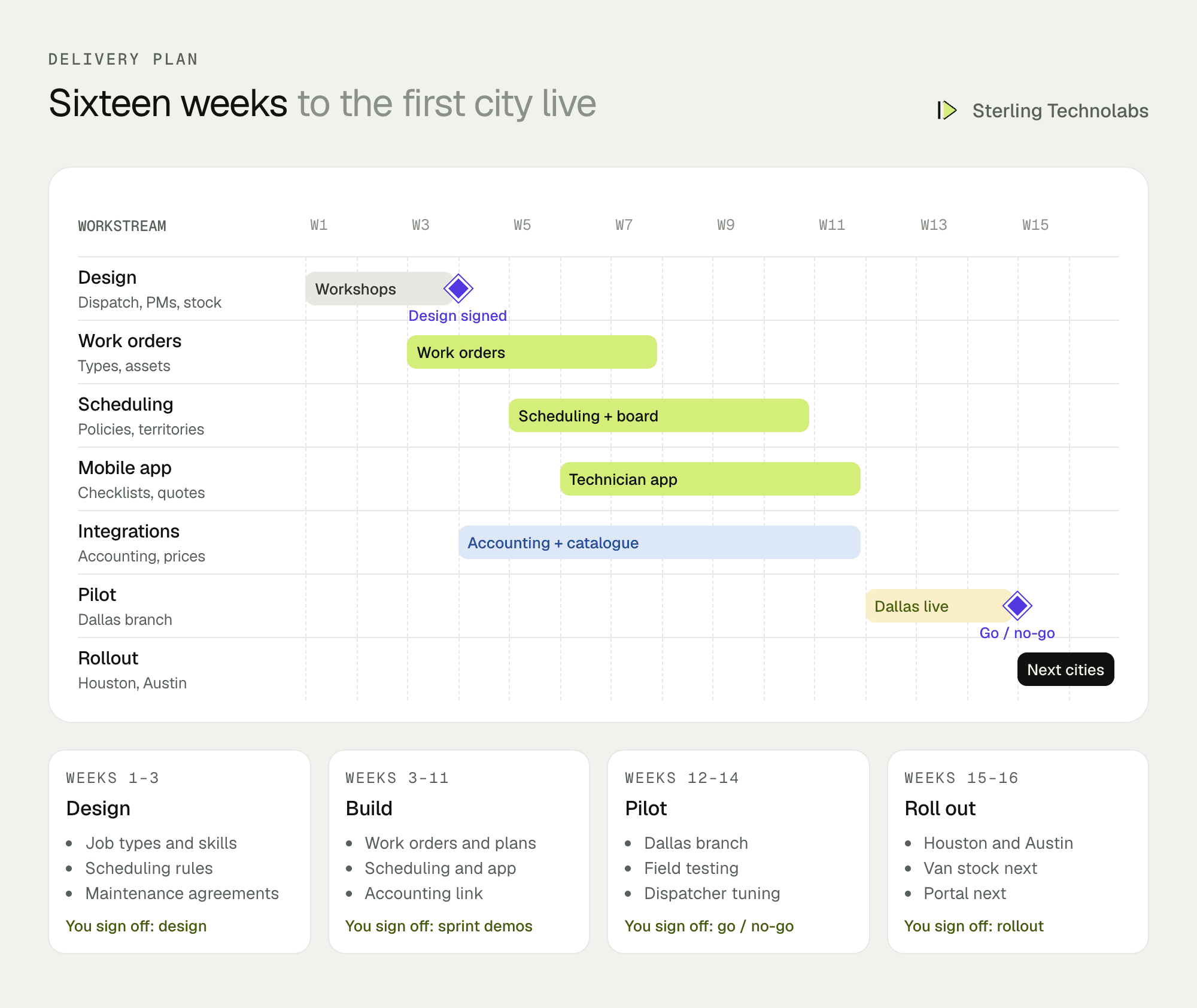
We'd go live in one city first, with maintenance plans, dispatch and the mobile app, while the other branches keep their current process. Van inventory and the customer portal follow once technicians are comfortable with the app. Summer is the worst time to change dispatch, so go-live is planned for the cooler months.
The team
| Role | Time | What they own |
|---|---|---|
| Salesforce solution architect | Part time | Field Service design, scheduling policies, integrations |
| Business analyst with field service experience | Full time | Dispatch, maintenance and inventory processes, UAT |
| Salesforce developers (2) | Full time | Configuration, flows, mobile app setup, portal |
| Integration developer | Weeks 4–11 | Accounting, price book and telematics integrations |
| QA engineer | Weeks 8–16 | Scheduling scenarios, offline tests, UAT |
From your side: a service manager, two dispatchers, three technicians who test the app in the field, and your accounting lead.
What changes the effort
- Number of technicians and territories. More territories mean more scheduling policies to tune.
- Inventory. Tracking van stock is a phase of its own; skipping it shortens the first release.
- Commercial complexity. Multi-site customers with contract pricing need more setup than residential jobs.
- Accounting system. A modern API is quicker than file exports.
- Existing data. Equipment lists and agreements in spreadsheets need cleaning before load.
Risks and how we'd handle them
| Risk | What we'd do |
|---|---|
| Technicians don't adopt the app | Technicians test it in the field from week 6, screens are kept short, and the app works offline. |
| Bad schedules in peak season | Scheduling policies tested on last summer's call data, dispatchers can always override, go-live before the heat. |
| Missed maintenance visits | Every agreement loaded as a maintenance plan, with a weekly report of visits due and overdue. |
| Inventory doesn't match | Van counts at go-live and monthly cycle counts in the app. |
| Licence cost | Licence types matched to roles: technicians, dispatchers and office staff need different ones. |
What we'd measure
| Metric | How we'd measure it | Baseline from |
|---|---|---|
| First-time fix rate | Jobs completed on the first visit | Current job records |
| Jobs per technician per day | Completed appointments per working day | Current schedules |
| Maintenance visits on time | Visits completed inside the agreement window | Agreement spreadsheet |
| Quote approval time | Quote created to customer approval | Paper quotes today |
| Days to invoice | Job completed to invoice sent | Accounting system |
Build or buy?
Dedicated HVAC dispatch software such as ServiceTitan is built for residential contractors and is often the faster choice for them. Salesforce Field Service fits contractors with a large commercial maintenance book, complex scheduling across territories, a sales team already on Salesforce, or plans to grow by acquisition. We'll tell you on the first call which is the better fit for your business.
Questions we'd ask on the first call
- How many technicians, branches and jobs a day, and what's the commercial-residential split?
- How are maintenance agreements scheduled today?
- How do you dispatch, and what goes wrong in peak season?
- Do you track parts on vans?
- Which accounting system do you use, and do you already have Salesforce?
FAQ
What is Salesforce Field Service?
It is Salesforce's field service management product: work orders, scheduling and dispatch, a mobile app for technicians, maintenance plans and inventory, on the same platform as sales and customer service.
Is Salesforce Field Service good for HVAC companies?
Yes, especially for contractors with commercial maintenance agreements, many technicians and territories, or a sales team already on Salesforce. Small residential shops often do better with HVAC-specific dispatch software.
Does the Salesforce Field Service mobile app work offline?
Yes. Technicians can view jobs, complete checklists, log parts and capture signatures without signal, and everything syncs when they reconnect.
How long does a Salesforce Field Service implementation take?
A first release for one branch, with dispatch, maintenance plans, the mobile app and accounting integration, typically takes 14 to 16 weeks.
:: Typical stack
Salesforce Field Service, Field Service mobile app, Service Cloud, Experience Cloud, Flow, accounting integration
:: Related service
Salesforce Service Cloud
See the service

Send us your brief. We’ll help turn it into reality
A senior engineer replies within one business day with questions or a first plan: approach, team, timeline and estimate.
More blueprints like this


