Telemedicine app development for a multi-state behavioral health group
Many practices run video visits on a patchwork of tools, with intake on paper and insurance checks by phone. This is how we'd build one branded telemedicine app where patients book, check coverage, pay and join, and clinicians run their day from one screen.
Industry
Behavioral health
Typical timeline
16–20 weeks
Typical team
6 people

The situation
Picture a behavioral health group with 45 therapists and 6 psychiatric nurse practitioners, licensed across Texas, Oklahoma and Louisiana. About 70% of its sessions already happen over video, but on a patchwork of tools: a general video app for sessions, a separate scheduling tool, intake forms on paper or email, and insurance checks by phone.
Patients get three different links and three different logins. Front-desk staff spend the morning calling payers to check eligibility and chasing unsigned consent forms. Clinicians open a session without the intake answers in front of them. No-shows are high, and nobody can say whether they come from bad reminders, a confusing joining process or something else.
The group wants one telemedicine app under its own brand: patients book, complete intake, check coverage, pay and join the session in one place, and clinicians run their day from one screen.
Signs this blueprint fits you
- You run a meaningful share of visits over video and patients juggle several apps and links.
- Intake, consent and insurance checks happen by phone, paper or email.
- Your clinicians work across several states and you need to match patients to licensed providers.
- You want your own branded patient app rather than a generic telehealth tool.
- Off-the-shelf telehealth software doesn't fit your intake, scheduling or billing rules.
What we'd build
- A patient app for iOS and Android, plus a web version, for booking, intake, payment, messaging and joining video visits with one tap.
- A clinician web app with today's schedule, a virtual waiting room, intake answers and history next to the video, and visit notes.
- HIPAA-compliant video visits through a video SDK covered by a business associate agreement, with a device and connection check before every session.
- Smart scheduling that only offers clinicians licensed in the patient's state and accepting the patient's insurance.
- Digital intake and consent: questionnaires such as PHQ-9 and GAD-7, consent forms with e-signature, and ID and insurance card capture.
- Insurance eligibility checks through a clearinghouse API before the visit, and card payments for copays and self-pay sessions.
- E-prescribing for nurse practitioners through a certified e-prescribing partner.
- Reminders and secure messaging by push, SMS and email, with no health details in the message itself.
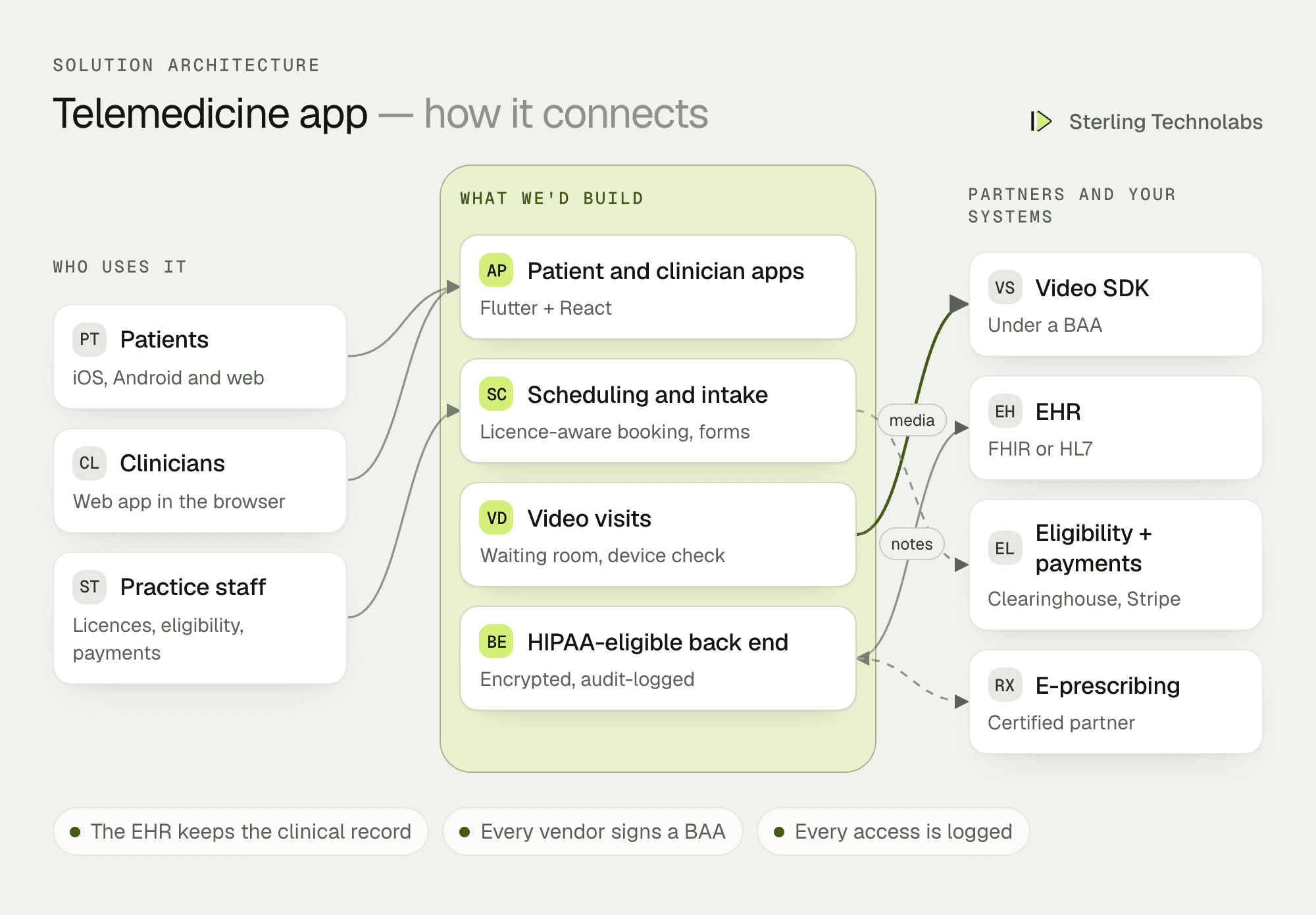
How the pieces fit
One back end, three front ends
The patient mobile app is built once in Flutter for iOS and Android. The patient web app and the clinician app are React web apps. All three use one back end that holds appointments, intake, messages and visit records, running in a HIPAA-eligible cloud account (AWS or Azure) under a signed BAA.
Video
We don't build video from scratch. A HIPAA-eligible video SDK, such as Zoom Video SDK or Vonage, handles the media, and we build the waiting room, joining flow and in-session tools around it. Sessions are not recorded unless your policy requires it.
Your EHR stays the clinical record
Visit notes, diagnoses and billing codes are written to your EHR through its FHIR API or HL7 interface where available. If your EHR has no usable API, notes stay in the app and are exported in a format your billing team can use. The telemedicine app handles everything around the visit; the EHR keeps the chart.
Security and compliance
Data is encrypted in transit and at rest, every access to patient data is logged, staff use single sign-on with multi-factor authentication, and sessions time out. Every vendor that touches patient data signs a BAA. We document these controls for your HIPAA risk assessment.
One appointment, end to end
Here is a new patient's first therapy session, from booking to the visit note.

The front desk did nothing by hand. Coverage was confirmed before the visit, the clinician had the intake scores on screen, and the patient used one app from start to finish.
What clinicians would see
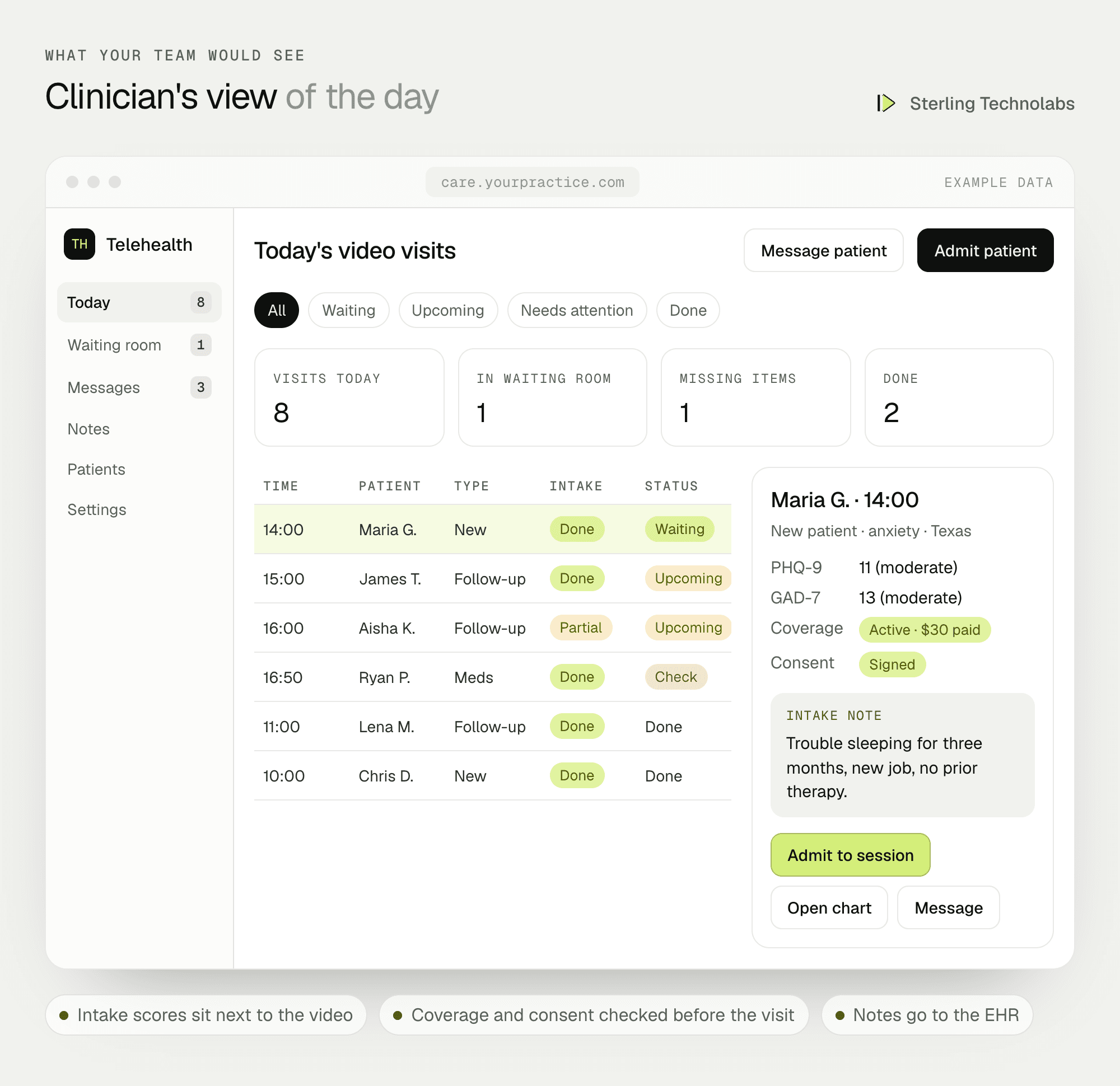
Clinicians see their day, who is in the waiting room, and anything missing before a session: an unsigned consent, an eligibility problem or an intake not completed. The patient's answers and history sit next to the video during the visit.
Telemedicine app features by user
| Patients | Clinicians | Practice staff |
|---|---|---|
| Book by state, insurance and specialty | Daily schedule and waiting room | Clinician licences by state |
| Intake, consent and e-signature | Intake scores and history in session | Eligibility results and exceptions |
| Insurance card and ID capture | HIPAA-compliant video visits | Copay and self-pay payments |
| Pay copays in the app | Visit notes to the EHR | No-show and utilisation reports |
| Secure messaging and reminders | E-prescribing (NPs) | Templates for intake and consent |
Data and integrations
| Integration | What it's for | Example options |
|---|---|---|
| Video SDK | Video visits under a BAA | Zoom Video SDK, Vonage |
| EHR | Patients, notes, billing codes | FHIR or HL7 interface |
| Eligibility | Real-time insurance checks | Clearinghouse API |
| Payments | Copays and self-pay | Stripe |
| E-prescribing | Prescriptions by NPs | Certified e-prescribing partner |
| Messaging | SMS and email reminders | HIPAA-eligible SMS and email providers |
Delivery plan
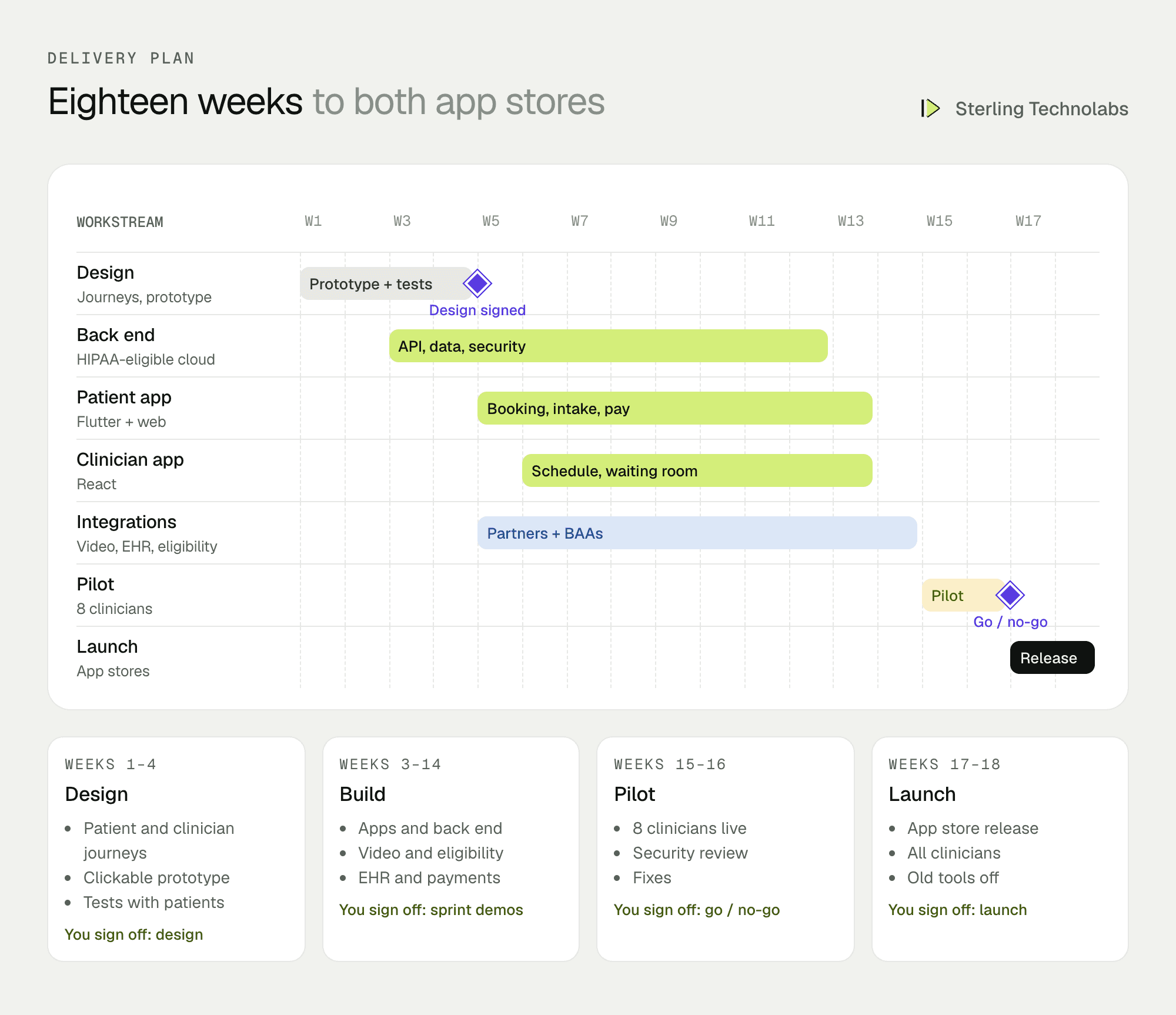
The first release covers booking, intake, eligibility, payments and video visits for all clinicians. E-prescribing and deeper EHR integration follow, because they depend on partner onboarding that runs in parallel. We test with a small group of clinicians and patients before opening the app to everyone, and both app store reviews are planned into the schedule.
The team
| Role | Time | What they own |
|---|---|---|
| Solution architect | Part time | Architecture, integrations, security controls |
| Product designer | Weeks 1–8 | Patient and clinician journeys, prototypes, usability tests |
| Flutter developer | Full time | Patient iOS and Android app |
| Full-stack developers (2) | Full time | Back end, clinician app, patient web app |
| QA engineer | Weeks 6–18 | Device testing, video quality, UAT, app store readiness |
From your side: a clinical lead, a practice manager, your compliance or privacy officer, and access to your EHR and billing contacts.
What changes the telemedicine app development cost
- Platforms. A patient web app alone is cheaper than iOS, Android and web. Flutter keeps the mobile cost close to one app instead of two.
- EHR integration. A modern FHIR API is the quicker path. Older EHRs, or none at all, change the approach and the effort.
- Insurance. Self-pay only is simpler. Eligibility checks and claim data add integration work.
- E-prescribing. Adds a certified partner, identity proofing for prescribers and extra testing.
- Group sessions and programs. Group therapy, care plans or remote monitoring are separate phases.
We give a written estimate after the first call, broken down by these choices, so you can decide what goes into the first release.
Risks and how we'd handle them
| Risk | What we'd do |
|---|---|
| Patient data exposure | BAAs with every vendor, encryption, audit logs, access by role, and a security review before launch. |
| Poor video on weak connections | Pre-visit device and network check, audio-only fallback, and testing on low-end phones and slow networks. |
| Clinician not licensed in the patient's state | Scheduling checks the patient's location against the clinician's active licences at booking and at joining. |
| App store rejection | Store guidelines reviewed during design, and review time planned into the schedule. |
| Clinicians keep old tools | Clinicians shape the waiting room and in-session screens, and the old tools are switched off on a set date. |
What we'd measure
| Metric | How we'd measure it | Baseline from |
|---|---|---|
| No-show rate | Missed video visits as a share of booked | Current scheduling data |
| Intake completion | Intake and consent done before the visit | Front-desk tracking |
| Time to join | Minutes from reminder tap to clinician connected | Not measured today |
| Front-desk time | Hours spent on eligibility and forms per week | Staff time study |
| Patient rating | Post-visit rating of the app and the call | None today |
Build or buy?
If you need video visits and nothing more, a ready-made telehealth platform is cheaper and faster. Custom telemedicine software development pays off when your intake, scheduling and billing rules are specific to your service line, when you want a patient app under your own brand that you can grow into care programs, or when per-provider subscription fees for several tools add up. One custom app can also replace several separate subscriptions.
Questions we'd ask on the first call
- How many clinicians, in how many states, and what share of visits are video today?
- Which EHR do you use, and does it have an API you can access?
- Do you bill insurance, self-pay or both?
- Do any of your clinicians prescribe?
- What tools are you using today, and what do they cost per month?
FAQ
How much does telemedicine app development cost?
It depends mostly on platforms, EHR integration, insurance handling and e-prescribing. We give a written estimate after the first call, with options for a smaller first release.
How long does it take to build a telemedicine app?
A first release with booking, intake, eligibility, payments and video visits typically takes 16 to 20 weeks, including app store review.
Is the app HIPAA compliant?
We build it with the safeguards HIPAA requires: BAAs with vendors, encryption, access controls and audit logs. Compliance also depends on your own policies, and we document our controls for your risk assessment.
Can it connect to our EHR?
Yes, if the EHR has a FHIR or HL7 interface. If not, we agree another way to get notes and billing data where they need to go.
:: Typical stack
Flutter (iOS and Android), React, Node.js, PostgreSQL, HIPAA-eligible video SDK, FHIR, Stripe, AWS
:: Related service
Mobile app development
See the service

Send us your brief. We’ll help turn it into reality
A senior engineer replies within one business day with questions or a first plan: approach, team, timeline and estimate.
More blueprints like this


