Shopify B2B wholesale portal for an apparel brand
Many apparel brands sell to retailers through sales reps, phone calls and Excel order forms. This is how we'd use Shopify Plus B2B to give wholesale buyers their own catalogue, prices and terms, alongside the existing D2C store.
Industry
Fashion and apparel
Typical timeline
8–10 weeks
Typical team
4 people

The situation
Picture an apparel brand making linen and cotton casualwear, selling direct to consumers on its Shopify store and wholesale to around 250 boutiques and multi-brand stores across India. Wholesale is roughly 40% of revenue and growing.
The D2C store runs smoothly. Wholesale runs on Excel. Each season, sales reps send line sheets as PDFs and order forms as spreadsheets. Retailers fill them in, often with sizes in the wrong columns, and email them back. Someone types every order into the ERP, discovers half the sizes are out of stock, and calls the retailer back. Different retailers have different prices, minimums and payment terms, and those live in the reps' heads. Reorders mid-season are slow enough that retailers sometimes fill the gap with another brand.
The brand already uses Shopify Plus. What it needs is a wholesale experience on the same platform: retailers log in, see their own prices and terms, order quickly by size, see stock before they order, and have orders flow straight into the ERP.
Signs this blueprint fits you
- Wholesale orders arrive by email, spreadsheet or WhatsApp.
- Prices, minimums and terms differ by retailer and are tracked outside your systems.
- Retailers order products they can't get, because stock isn't visible.
- You're on Shopify Plus, or planning to move.
What we'd build
- Shopify Plus B2B setup: companies with locations, buyers, payment terms, tax details and credit limits.
- Catalogues and price lists per retailer segment and region, so each buyer sees only their products at their prices.
- Custom theme sections for wholesale: quick order, size-by-colour grids, pack sizes, new-drop collections and reorder from past orders.
- Shopify Functions for wholesale rules: order minimums, pack multiples, volume discounts and payment-term logic.
- ERP integration for stock, orders, invoices and credit, so retailers see real availability and orders don't need retyping.
- Klaviyo flows for wholesale buyers: new drop announcements, reorder reminders and back-in-stock alerts.
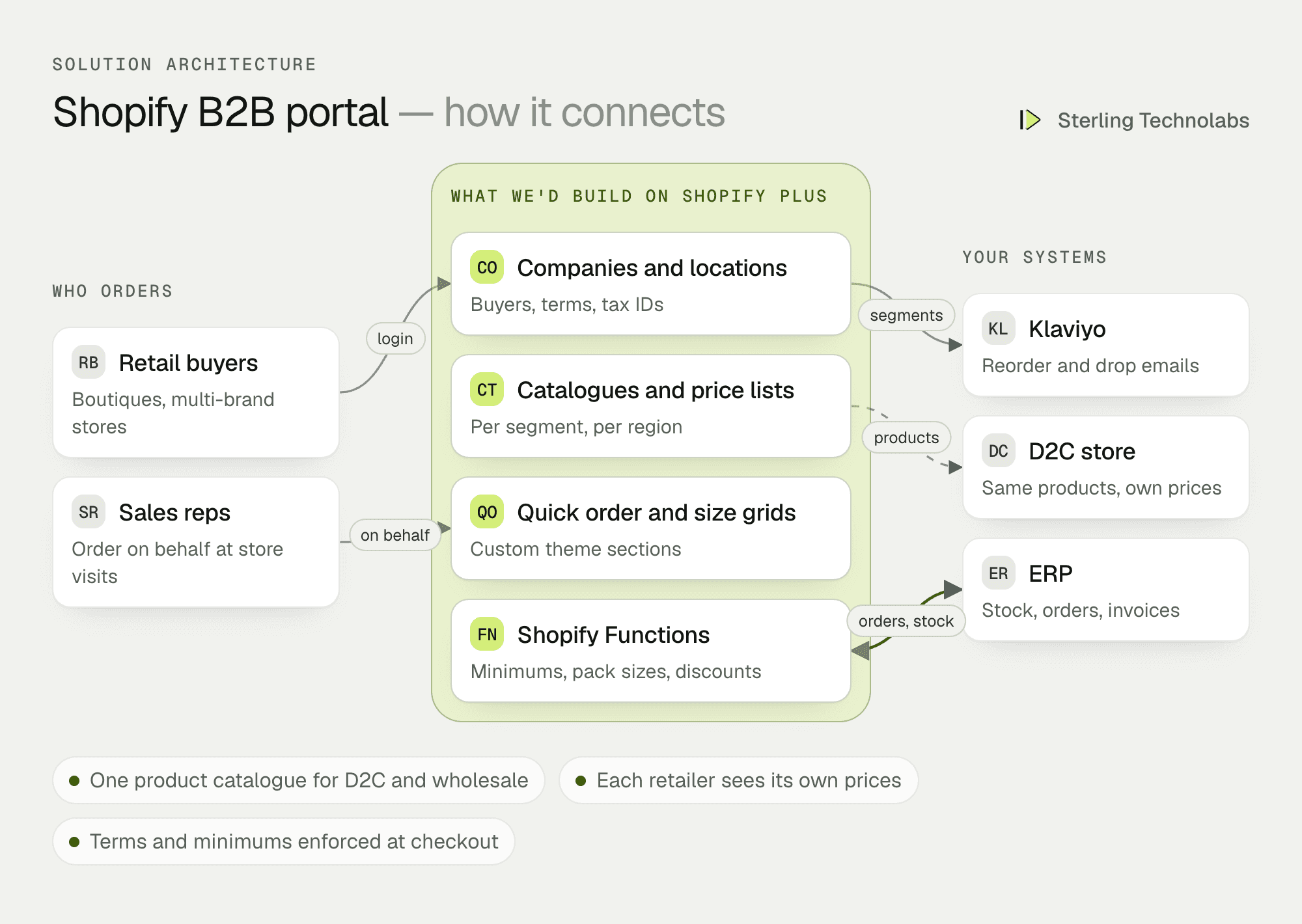
How the pieces fit
One store, two experiences
With Shopify Plus B2B, wholesale can run on the same store as D2C, or on a separate B2B storefront that shares the same products. Either way, products, images and inventory are managed once. Retailers log in and see wholesale prices, pack sizes and terms; consumers never see any of it.
Companies, not customers
Each retailer is a company with one or more locations and several buyers. Terms such as net 30, credit limits and tax IDs sit on the company, and each location can have its own catalogue. Sales reps can place orders on a company's behalf during store visits.
Ordering the way buyers think
Wholesale buyers think in styles, colours and size runs, not individual product pages. The quick-order grid lets them enter quantities for a whole style across sizes and colours in one view, with packs and stock shown inline.
Rules at checkout
Shopify Functions enforce the commercial rules: minimum order value per segment, pack multiples per style, tiered volume discounts. Because they run in Shopify's checkout, the rules apply consistently whether the retailer or a rep places the order.
One reorder, end to end
Here is a mid-season reorder from a boutique in Bengaluru.
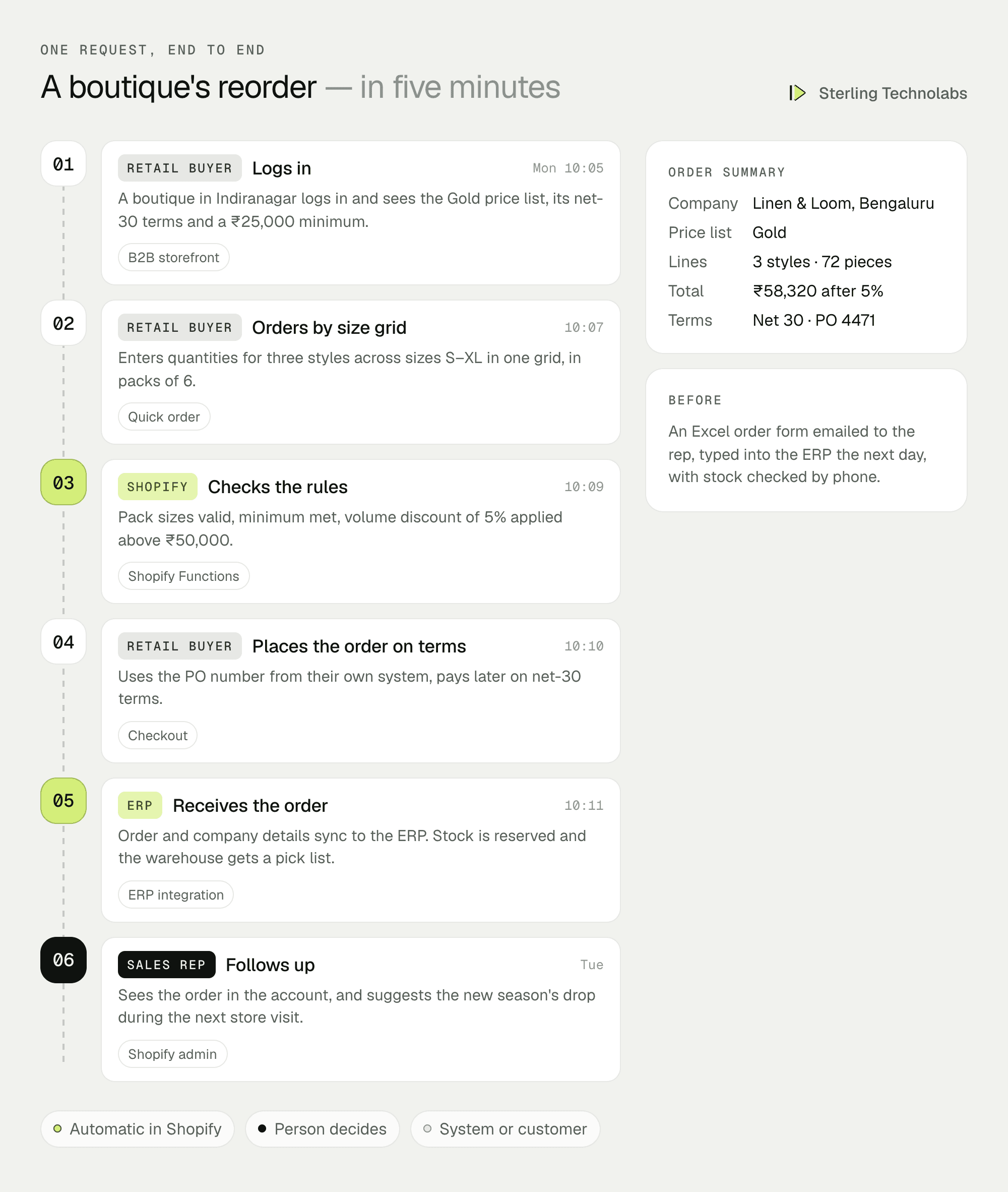
What retail buyers would see
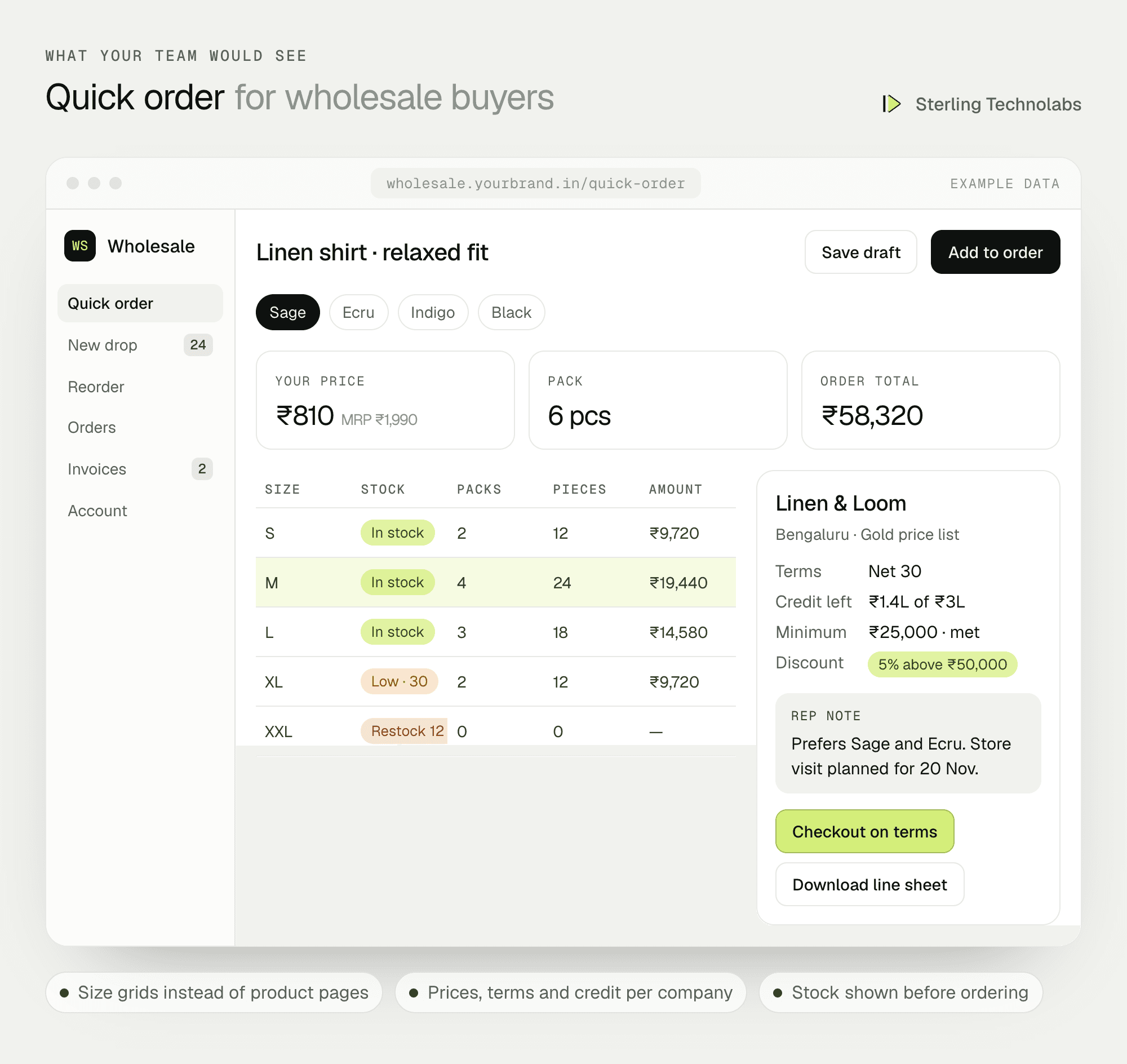
Buyers order a full style in one grid, see their price and stock as they go, and know immediately whether they've met their minimum and earned a volume discount. Their account shows terms, credit, invoices and past orders for quick reorders.
Data and integrations
| System | What flows | Direction | How we connect |
|---|---|---|---|
| ERP (Tally, SAP B1, Unicommerce) | Stock by warehouse | ERP to Shopify | Scheduled sync or middleware |
| ERP | Wholesale orders, company and PO details | Shopify to ERP | Order webhook to ERP API |
| ERP | Invoices, payments, credit used | ERP to Shopify | Company metafields, nightly |
| Klaviyo | Wholesale segments, reorder and drop emails | Shopify to Klaviyo | Native integration |
| D2C store | Shared products and inventory | Within Shopify | Same store or expansion store |
Delivery plan

The pilot invites fifteen retailers who order often and give honest feedback, plus the reps who serve them. After two weeks of real orders, the remaining accounts are invited and the Excel order forms are retired for the next season.
The team
| Role | Time | What they own |
|---|---|---|
| Shopify solution lead | Part time | B2B setup, pricing structure, integration design |
| Shopify developer | Full time | Theme sections, quick order, account pages |
| Functions developer | Weeks 3–6 | Minimums, pack sizes, discounts |
| Integration developer | Weeks 3–8 | ERP sync for stock, orders, invoices |
From your side: the head of wholesale, two sales reps, someone from finance for terms and credit, and your ERP vendor or admin.
What changes the effort
- Pricing structure. A few price lists by segment are quick. Retailer-specific prices for hundreds of accounts need data clean-up.
- ERP integration. Off-the-shelf connectors cover some ERPs; others need a custom sync.
- Pre-orders. Selling next season's collection on pre-order adds its own flow and stock logic.
- Same store or separate. Wholesale on the D2C store is simpler to run; a separate expansion store gives more control over design.
- Multiple currencies. International wholesale adds markets and currency handling.
Risks and how we'd handle them
| Risk | What we'd do |
|---|---|
| Retailers prefer email | Make the portal faster than the old form, involve reps in onboarding, and offer reorder in two clicks. |
| Consumers see wholesale prices | Catalogues assigned to companies only, tested with consumer and buyer accounts before launch. |
| Stock shown isn't real | ERP stock synced on a schedule agreed with the warehouse, with a safety buffer for fast sellers. |
| Credit limits exceeded | Credit used synced from the ERP, with orders over the limit held for approval. |
| Channel conflict with D2C | Clear rules on which products and discounts are wholesale-only, agreed before setup. |
What we'd measure
| Metric | How we'd measure it | Baseline from |
|---|---|---|
| Portal order share | Wholesale orders placed in the portal | Zero today |
| Order entry time | Time from order received to order in the ERP | Current email-to-ERP time |
| Order errors | Orders amended because of size, stock or price mistakes | Current amendments |
| Reorder frequency | Mid-season reorders per retailer | Last two seasons |
| Average wholesale order value | Per order, before and after volume discounts | Last two seasons |
Build or buy?
If you're on Shopify Plus, its native B2B features should be the foundation; there's little reason to build a separate wholesale platform. B2B apps can add wholesale features to non-Plus stores, but they bring their own limits and fees. The custom work is in the buyer experience, such as size grids and quick order, the commercial rules in Functions, and a reliable ERP integration. That's where wholesale portals succeed or fail.
Questions we'd ask on the first call
- How many wholesale accounts, and how do they order today?
- How are wholesale prices, minimums and terms structured?
- Which ERP holds stock and invoices?
- Do your reps take orders during store visits?
- Do you sell next season on pre-order?
FAQ
Do we need Shopify Plus?
For native B2B with companies, catalogues, terms and Functions, yes. Without Plus, a B2B app can cover basic wholesale, with some limits.
Can retailers pay later on terms?
Yes. Payment terms such as net 30 are set per company, and orders can be placed without paying at checkout.
Can sales reps order for retailers?
Yes. Reps can place orders on behalf of companies from the admin, using the retailer's prices and terms.
:: Typical stack
Shopify Plus B2B, custom theme sections, Shopify Functions, ERP integration, Klaviyo
:: Related service
Shopify development
See the service

Send us your brief. We’ll help turn it into reality
A senior engineer replies within one business day with questions or a first plan: approach, team, timeline and estimate.
More blueprints like this


