Equipment rental marketplace app for contractors
Contractors still phone around to find equipment while yards have machines sitting idle. This is how we'd build a marketplace app where contractors book from many rental yards in minutes and yards get paid automatically.
Industry
Construction and equipment rental
Typical timeline
16–20 weeks
Typical team
6 people

The situation
Picture a construction equipment dealer group in Texas that sells and services machines across Dallas–Fort Worth, Houston and San Antonio. It works with hundreds of independent rental yards, and sees the same problem every week: contractors can't easily find who has a machine available, and yards have machines sitting idle while a contractor across town calls around for the same thing.
Today, a contractor who needs a mini excavator tomorrow calls three or four yards. Some are out of stock, some don't answer after 5 pm, and quotes come back the next morning by email. Delivery tickets are on paper, and disputes about damage and fuel are settled by memory. Independent yards have no easy way to reach contractors outside their own customer list, and most can't afford to build online booking themselves.
The dealer group wants to build an equipment rental marketplace: a web and mobile app where contractors find, book and pay for equipment from many yards, and yards fill idle machines without changing how they run.
Signs this blueprint fits you
- You want to connect many suppliers with many buyers, and take a fee on each transaction.
- Buyers find suppliers by phone, email or word of mouth today.
- Suppliers have idle capacity they can't easily sell.
- Bookings need dates, availability, deposits and hand-over records.
- Off-the-shelf marketplace software doesn't handle your rental rules.
What we'd build
- Listings and search: equipment by category, specs and attachments, with search by location, dates and delivery radius, using real availability.
- Booking and payments: daily, weekly and monthly rates, deposits, delivery fees, damage waivers, and marketplace payouts to yards minus the platform fee.
- Insurance verification: contractors upload certificates of insurance, checked before the first rental and tracked for expiry.
- A yard dashboard on web and phone: requests, availability, fleet listings, today's deliveries and returns, and payouts.
- Mobile apps for contractors to search, book and manage rentals, and for drivers to run deliveries.
- Delivery and check-in: delivery windows, check-out and return photos, hour meter and fuel readings, and signatures on the driver's phone.
- Marketplace admin: yard approval, fees, disputes, refunds, reviews and reporting.
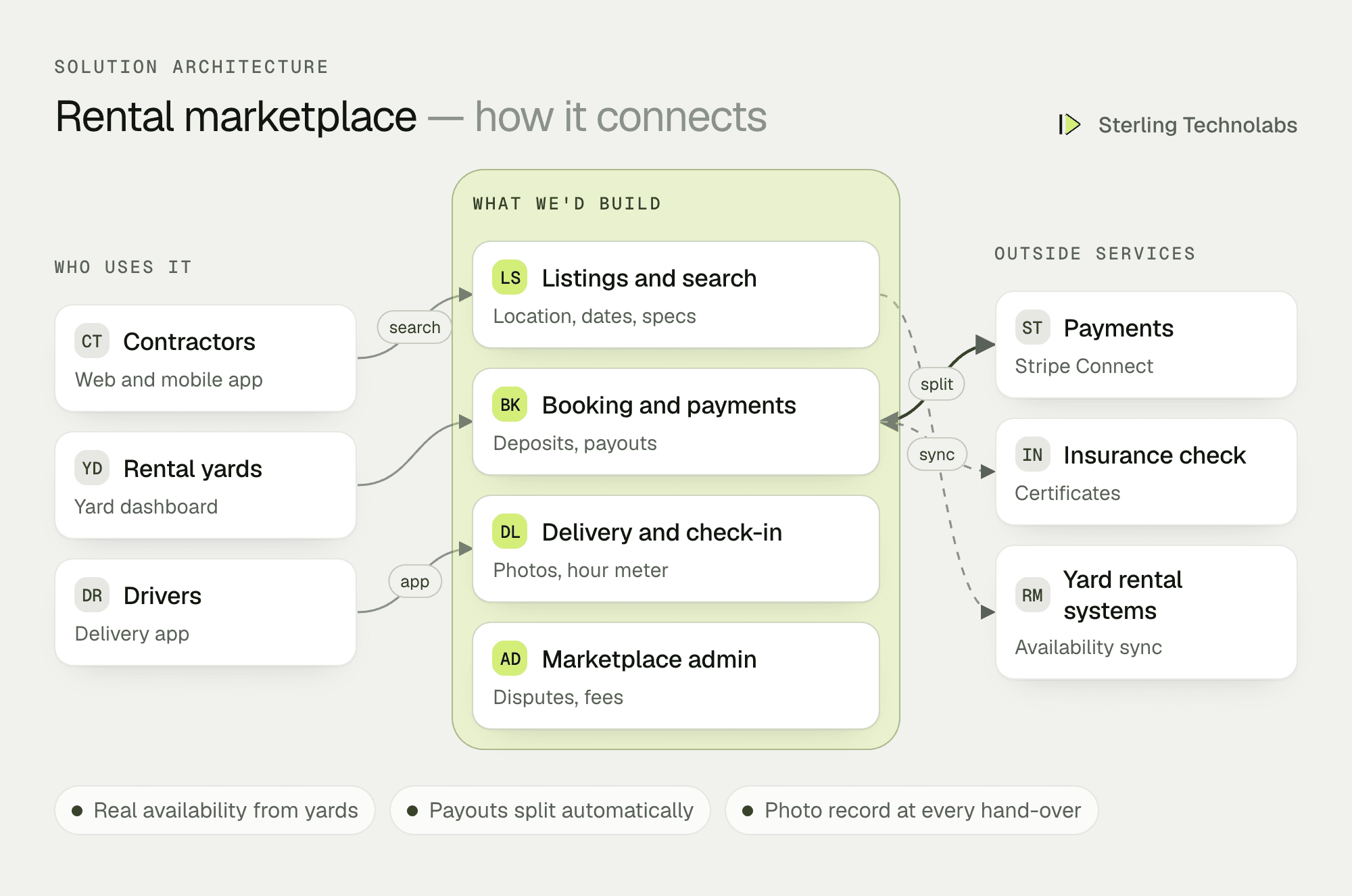
How the pieces fit
Availability that yards can trust
A marketplace fails if bookings bounce. Yards can manage availability in the dashboard, block dates for their own customers, and require approval for some machines. For larger yards with a rental management system, we'd sync availability through its API so the marketplace never offers a machine already on rent. Requests not answered within an hour are offered to the next yard.
Payments split automatically
Payments run through a marketplace payment provider such as Stripe Connect. The contractor pays a deposit when booking and the balance on return, based on actual days and any extra charges. The provider holds the money, pays out each yard on a schedule, and keeps the platform fee. Yards complete identity and bank checks with the provider, so the dealer group doesn't hold yards' bank details.
A photo record at every hand-over
Most rental disputes are about damage, fuel and hours. At delivery and return, the driver's app requires photos from set angles, the hour meter reading and fuel level, and a signature. If there's a disagreement, both sides see the same record, and the admin team decides with evidence.
Start with one city
Marketplaces need enough supply that contractors find what they need on the first search. We'd launch in Dallas–Fort Worth with about 40 yards signed up and their fleets listed before contractors are invited, then open Houston and San Antonio once bookings are steady.
One rental, end to end
Here is a contractor who needs a mini excavator on site early the next morning.

The contractor booked in four minutes in the evening, the yard rented a machine that would have sat idle, and the payout happened without an invoice.
What rental yards would see

Yards see requests to answer, today's deliveries and returns, machines on rent and payouts. Contractors see their bookings, invoices and saved sites in the app.
Marketplace app features by user
| Contractors | Rental yards | Marketplace operator |
|---|---|---|
| Search by location, dates and specs | Requests on the phone | Yard approval and onboarding |
| Book and pay in minutes | Availability and fleet listings | Fees, refunds and disputes |
| Insurance on file | Delivery and return schedule | Reviews and quality checks |
| Rental history and invoices | Payouts by booking | Bookings and revenue reports |
Data and integrations
| Integration | What it's for | Example options |
|---|---|---|
| Marketplace payments | Deposits, charges, payouts, fees | Stripe Connect |
| Maps and routing | Search radius, delivery fees, driver routes | Google Maps Platform |
| Yard rental systems | Availability sync for larger yards | Their rental management system's API |
| Insurance verification | Certificates of insurance | Upload with review, or a verification service |
| Messaging | Booking updates by text and push | Twilio, Firebase |
| Accounting | Platform fees and revenue | QuickBooks or Xero |
Delivery plan
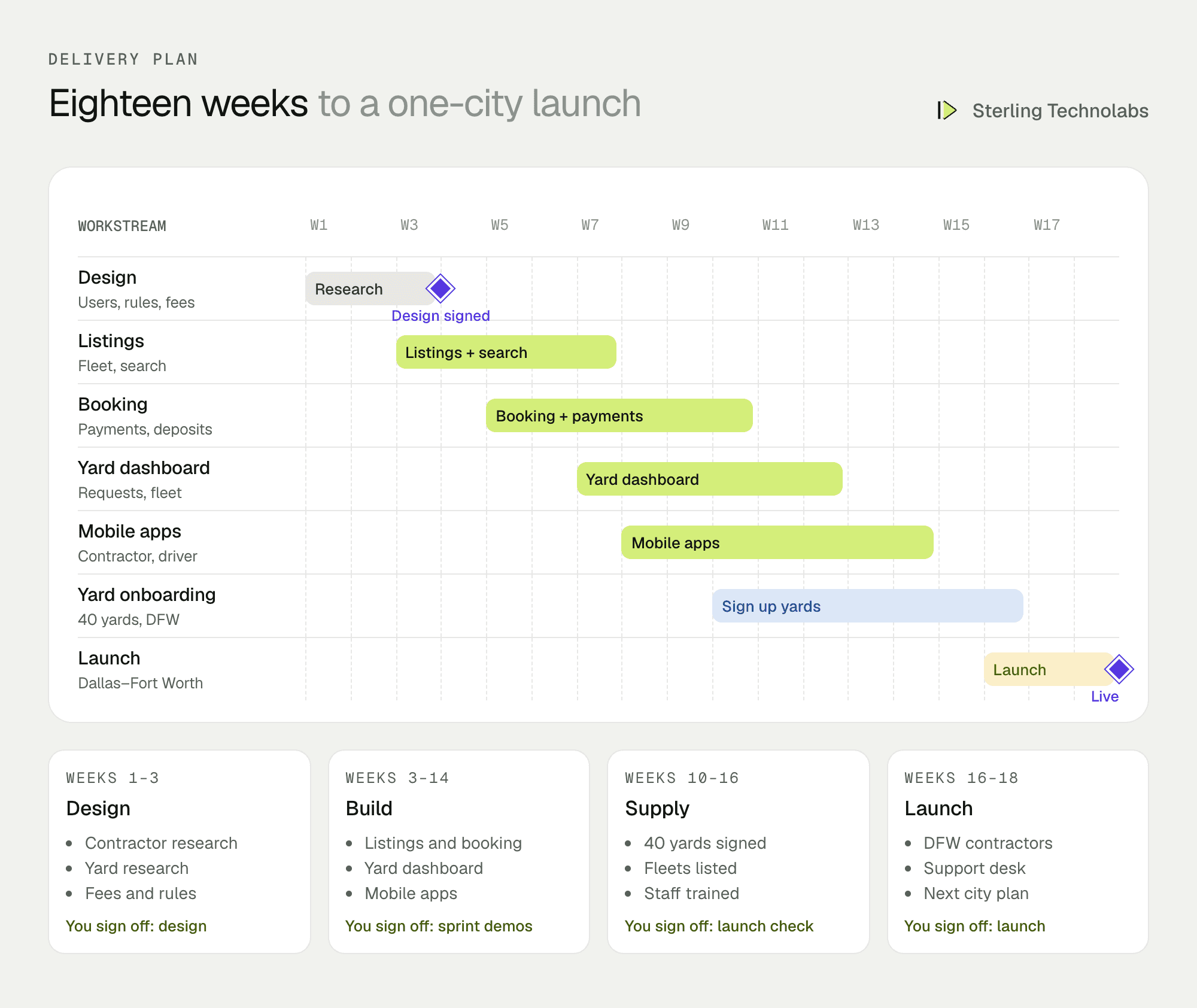
Signing up yards runs alongside the build, so the marketplace has supply on launch day. After launch, we'd add the next city, yard rental system integrations, and long-term rentals with monthly billing.
The team
| Role | Time | What they own |
|---|---|---|
| Solution architect | Part time | Architecture, payments, integrations |
| Product designer | Weeks 1–10 | Contractor, yard and driver experiences |
| Full-stack developers (2) | Full time | Listings, booking, payments, yard dashboard, admin |
| Mobile developer | Full time | Contractor and driver apps |
| QA engineer | From week 6 | Booking and payment tests, device tests, launch support |
From your side: a marketplace lead, someone to sign up and support yards, a few contractors and yard managers to test, and your finance lead for fees and payouts.
What changes the effort
- Pricing rules. Simple day rates are quick; minimum hires, weekend rates and seasonal pricing take longer.
- Availability sync. Yards using the dashboard are quick; syncing with their rental systems adds an integration per system.
- Delivery. Yard-run delivery is simpler than a marketplace delivery network.
- Payments. Card payments are standard; invoicing with net 30 terms for large contractors adds credit checks and collections.
- Equipment types. Each category with special rules, such as operator-required machines, adds work.
Risks and how we'd handle them
| Risk | What we'd do |
|---|---|
| Not enough supply at launch | 40 yards signed and fleets listed before contractors are invited, in one city only. |
| Bookings bounce | Response time limits, automatic offers to the next yard, and availability sync for larger yards. |
| Damage disputes | Required photos and readings at every hand-over, and a clear dispute process. |
| Uninsured renters | Certificates checked before the first rental and tracked for expiry. |
| Yards and contractors deal off-platform | Fair fees, payment protection and insurance checks only available on the platform. |
What we'd measure
| Metric | How we'd measure it | Baseline from |
|---|---|---|
| Search to booking rate | Searches that end in a booking | Launch onwards |
| Request acceptance | Requests accepted by yards within an hour | Launch onwards |
| Repeat contractors | Contractors booking again within 90 days | Launch onwards |
| Yard utilisation | Days on rent for listed machines | Yard estimates before launch |
| Disputes | Bookings with a damage or charge dispute | Launch onwards |
Build or buy?
Marketplace software products can launch a simple marketplace quickly, and they are a sensible way to test demand. Custom marketplace app development makes sense when your rules, such as rental dates, deposits, delivery, insurance and hand-over records, don't fit those products, or when the marketplace is the business and you need to own the product and data. Some founders test with a product, then build custom once demand is proven.
Questions we'd ask on the first call
- Who are your suppliers and buyers, and how do they find each other today?
- How many suppliers can you sign up before launch?
- How will you price: commission, subscription or both?
- What happens at hand-over, and what goes wrong?
- Which city or region would you launch in first?
FAQ
What is marketplace app development?
Building a web and mobile platform where many suppliers list what they offer, buyers search and book, and the marketplace handles payments and takes a fee.
How do marketplace payments work?
A marketplace payment provider, such as Stripe Connect, takes the buyer's payment, pays each supplier and keeps the platform fee, so the operator doesn't hold suppliers' bank details.
How much does custom marketplace development cost?
It depends mostly on booking and pricing rules, payments, mobile apps and integrations. We give a written estimate after the first call, with a smaller first release as an option.
How long does it take to build a marketplace app?
A first release with web and mobile apps, booking, payments, a supplier dashboard and admin typically takes 16 to 20 weeks.
:: Typical stack
React, React Native, Node.js, PostgreSQL, Stripe Connect, Google Maps Platform, Twilio, rental system APIs
:: Related service
Web development
See the service

Send us your brief. We’ll help turn it into reality
A senior engineer replies within one business day with questions or a first plan: approach, team, timeline and estimate.
More blueprints like this


