Fintech software development for a small-business lending platform
Many lenders still take applications as PDFs and decide in days. This is how we'd build fintech software for small-business lending: a fast application, bank data instead of statements, every check automated and credit decisions left with underwriters.
Industry
Lending and fintech
Typical timeline
18–22 weeks
Typical team
7 people

The situation
Picture a US lender that offers working-capital loans and lines of credit to small businesses: restaurants, contractors, clinics and retailers borrowing $25,000 to $250,000. It is growing through broker partners and its own website, and wants to launch its own digital lending app.
Today, applications come in as PDFs and emailed bank statements. An operations team re-keys everything into spreadsheets and a loan servicing tool, orders business credit reports by hand, chases missing documents by phone and sends contracts for e-signature one by one. A simple application takes four to six days to decision. Good borrowers sign elsewhere in the meantime, and brokers send their best files to faster lenders.
The lender wants fintech software that lets a business owner apply in fifteen minutes, connects bank accounts instead of uploading statements, and gives underwriters a complete file in one place, without taking credit decisions away from its credit team.
Signs this blueprint fits you
- Applications arrive as PDFs and email, and someone re-keys them.
- Time to decision is measured in days and you lose deals to faster lenders.
- KYC, KYB and credit checks are run by hand in separate tools.
- Brokers or partners have no portal to submit and track deals.
- Your credit policy is specific, and loan origination products don't model it well.
What we'd build
- A borrower app on web, iOS and Android: a short application, bank account connection, document upload, e-signature and, after funding, balances, statements and payments.
- A broker portal where partners submit deals, upload documents, see status and track commissions.
- Identity and business verification: KYC on owners, KYB on the business, sanctions and watchlist screening, through specialist providers.
- Bank data and cash-flow analysis from connected accounts: average balances, deposits, NSF days and existing debt payments, calculated automatically.
- A rules-based underwriting workspace where your credit policy runs as rules, produces a recommendation and a reason list, and an underwriter makes the decision.
- Offers, contracts and funding: pricing from your rate cards, contracts generated and e-signed, and funds sent by ACH.
- Servicing and collections basics: repayment schedules, ACH debits, failed-payment handling and borrower notices.
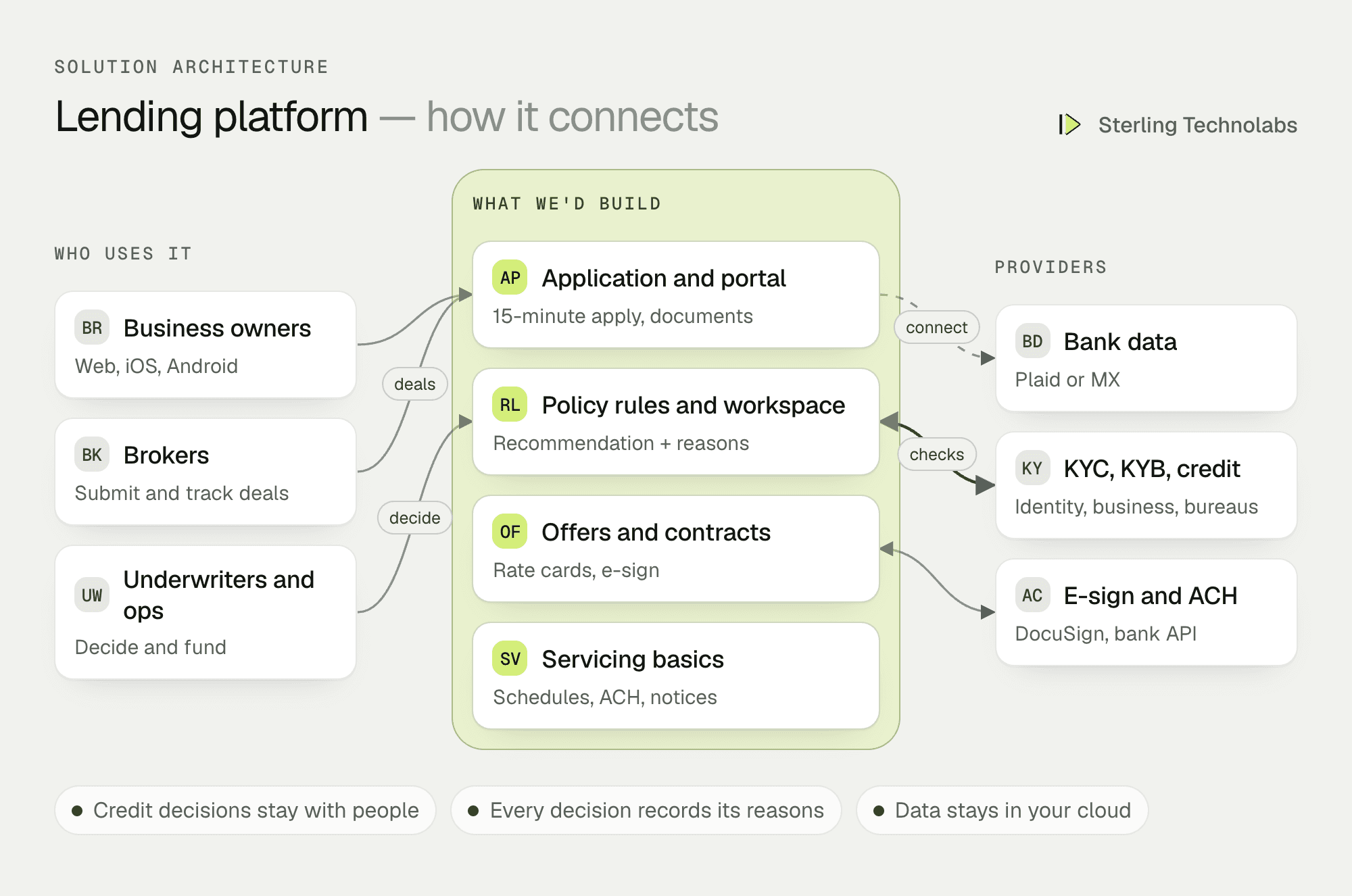
How the pieces fit
Buy the regulated plumbing, build the lending logic
Good fintech software development doesn't rebuild what specialist providers already do well. Bank connections, identity verification, credit bureau data, e-signature and ACH payments come from established providers through their APIs. What we build is what makes your lending business different: the application flow, your credit policy as rules, the underwriting workspace, pricing, the broker experience and the data model that ties them together.
Credit decisions stay with people
The rules engine applies your policy consistently: minimum time in business, revenue thresholds, cash-flow ratios, industry exclusions. It produces a recommendation and every reason behind it. Underwriters approve, decline or counter-offer, and can override with a note. Declines generate an adverse action notice listing the principal reasons, as fair lending rules require.
Security and compliance by design
Borrower data is encrypted in transit and at rest, access is by role, and every action on an application is logged. The platform runs in your own cloud account with infrastructure as code, so a SOC 2 audit has evidence from day one. Your compliance counsel decides the policies; the software makes them enforceable and auditable.
Loan servicing
For a first release, repayment schedules, ACH debits and failed-payment handling are built in. If you already use a loan servicing platform, we integrate with it instead, and the borrower app shows balances and payments from there.
One application, end to end
Here is a restaurant owner applying for a $120,000 working-capital loan, from first click to funding.
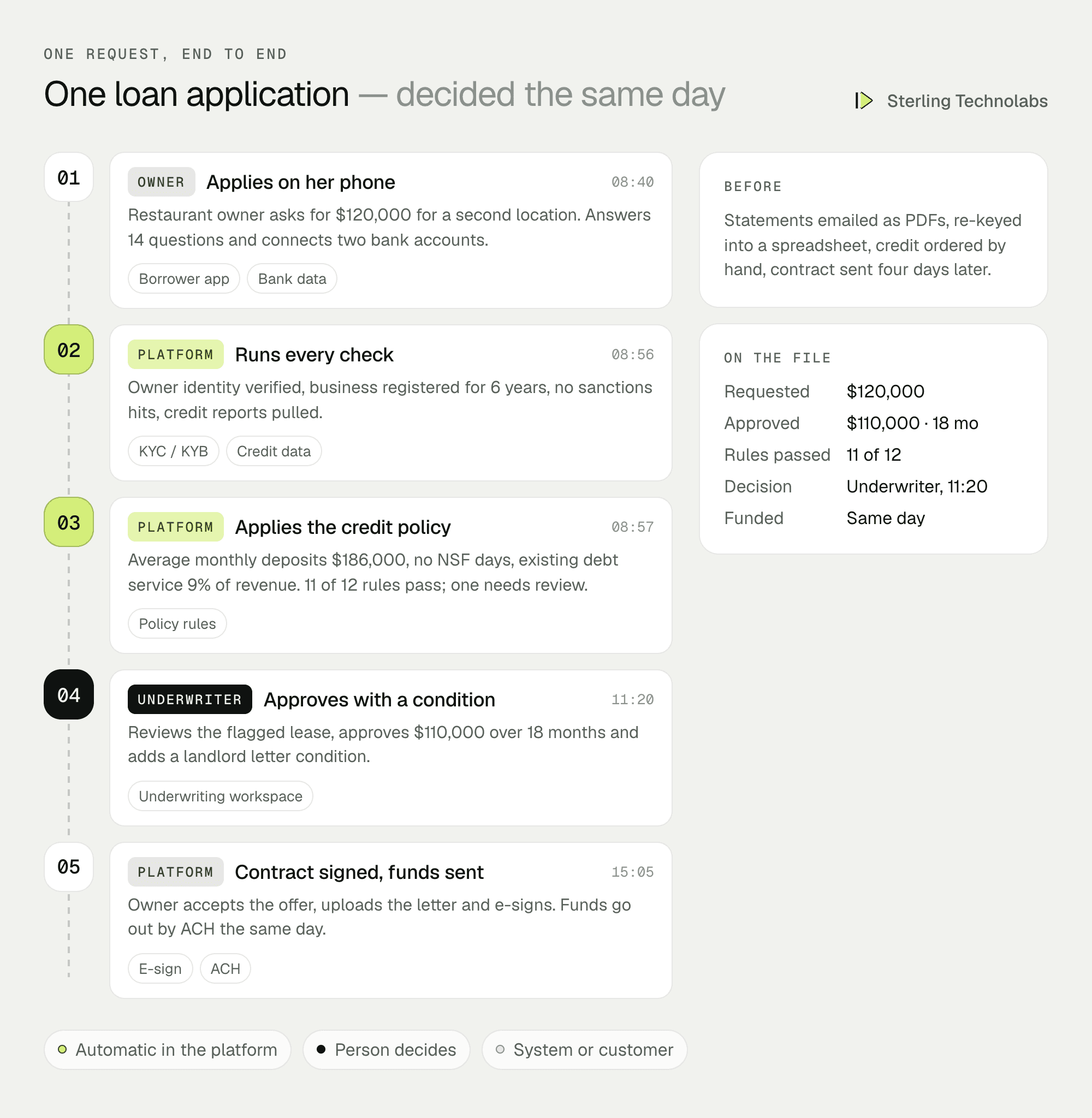
The owner never uploaded a bank statement, the underwriter got a complete file with every check already run, and the decision took hours instead of days. The credit decision was still made by a person.
What underwriters would see
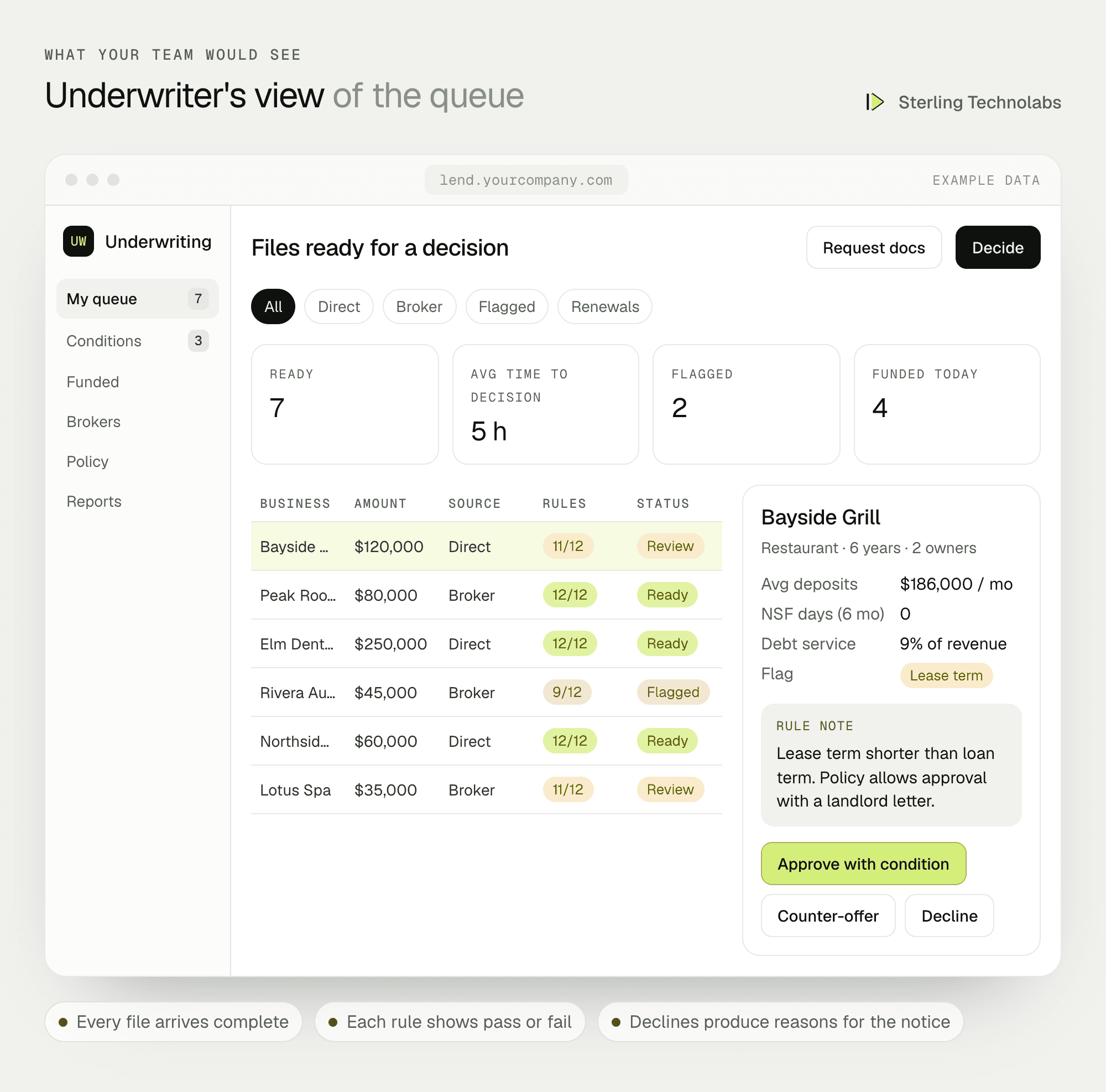
Underwriters work a queue of complete files. Each opens to the business, the owners, the verification results, the cash-flow figures and the policy rules that passed or failed, so they spend their time on judgement rather than collection.
Fintech app features by user
| Borrowers | Brokers | Underwriting and operations |
|---|---|---|
| 15-minute application | Deal submission | Complete files in one queue |
| Bank account connection | Document upload | Policy rules with reasons |
| E-signature | Status tracking | Pricing from rate cards |
| Balances and payments | Commission statements | Adverse action notices |
Data and integrations
| Integration | What it's for | Example options |
|---|---|---|
| Bank data | Account connection and transactions | Plaid, MX |
| KYC and KYB | Owner identity, business verification, sanctions | Persona, Alloy, Middesk |
| Credit data | Business and personal credit reports | Experian, Equifax |
| E-signature | Loan agreements | DocuSign |
| Payments | Funding and repayments by ACH | Your bank's API, Stripe, Dwolla |
| CRM | Broker and borrower relationships | Salesforce or HubSpot |
Delivery plan
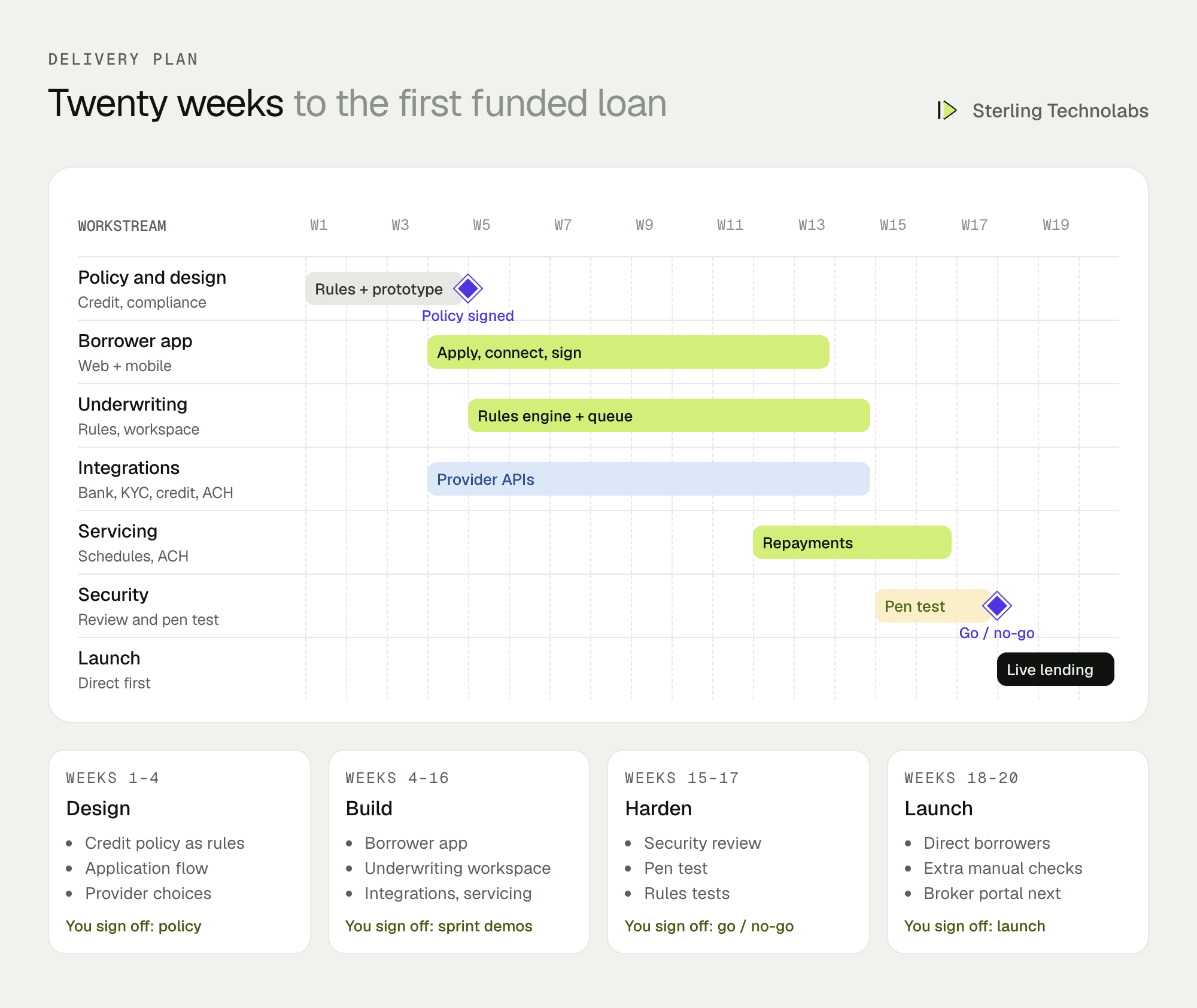
The first release covers application, verification, cash-flow analysis, underwriting, offers, e-signature and funding for one product, the term loan. The broker portal and the line of credit follow. A security review and penetration test happen before the first real borrower, and the first weeks of live lending run with extra manual checks.
The team
| Role | Time | What they own |
|---|---|---|
| Solution architect | Part time | Architecture, security, provider integrations |
| Business analyst with lending experience | Full time | Credit policy as rules, workflows, UAT |
| Product designer | Weeks 1–8 | Application flow, underwriting workspace |
| Back-end developers (2) | Full time | Rules engine, integrations, servicing |
| Front-end and Flutter developers (2) | Full time | Borrower app, broker portal, internal tools |
| QA engineer | From week 6 | Rules testing, integration tests, security checks |
From your side: your head of credit, operations lead, compliance counsel, and a few brokers willing to test the portal.
What changes the effort
- Products. One term loan is the simplest start. Lines of credit, merchant cash advances or equipment finance each add rules and servicing logic.
- Servicing. Building basic servicing is quicker than integrating a full servicing platform, but a platform handles complex cases better.
- Channels. Direct borrowers only is simpler than direct plus brokers plus embedded partners.
- Automation level. Underwriter decisions on every file are simpler than automatic approvals, which need more testing and monitoring.
- Mobile. A responsive web app may be enough for a first release; native apps can follow.
Risks and how we'd handle them
| Risk | What we'd do |
|---|---|
| Fraudulent applications | Identity, business and bank account checks on every file, device and duplicate checks, and manual review for anything flagged. |
| Inconsistent decisions | Policy runs as versioned rules, every decision records the reasons and the rule version, and overrides need a note. |
| Fair lending and notice gaps | Adverse action reasons generated from the rules, reviewed by your counsel before launch. |
| Data breach | Encryption, least-privilege access, audit logs, penetration test, and only the data you need stored. |
| Provider outages | Status monitoring and a manual fallback for each provider, so applications queue rather than fail. |
What we'd measure
| Metric | How we'd measure it | Baseline from |
|---|---|---|
| Time to decision | Application submitted to decision | Current spreadsheets |
| Time to funding | Decision to funds sent | Current process |
| Application completion | Started applications that are submitted | Website analytics |
| Files complete on arrival | Files needing no follow-up for documents | Operations log |
| Early defaults | Loans 30+ days past due in the first 90 days | Servicing records |
Build or buy?
Loan origination platforms are a good fit if your products and policy are standard and speed to market matters most. Custom fintech software development makes sense when your credit policy, broker model or borrower experience is part of your edge, when platform fees grow with every loan, or when you want to own your data and roadmap. A common middle path is to buy the regulated components and build the lending logic, which is what this blueprint does.
Questions we'd ask on the first call
- Which loan products, sizes and borrowers are you targeting?
- How do you underwrite today, and how documented is the credit policy?
- What share of volume comes from brokers or partners?
- Which providers do you already use for banking, KYC and servicing?
- What do your compliance and audit requirements look like?
FAQ
How long does fintech app development take?
A first release of a lending app for one product, with verification, underwriting, e-signature and funding, typically takes 18 to 22 weeks, including security testing.
What does fintech software development cost?
It depends mostly on products, channels, integrations and how much servicing you build. We give a written estimate after the first call, with a smaller first release as an option.
Do you build the credit model?
We implement your credit policy as rules and give underwriters the data to apply it. The policy and decisions remain yours.
Can the app work with our existing loan servicing system?
Yes. We integrate with servicing platforms through their APIs, or build basic servicing if you don't have one yet.
:: Typical stack
React, Flutter, Node.js, PostgreSQL, Plaid, KYC and KYB providers, credit bureau APIs, DocuSign, ACH, AWS
:: Related service
Custom software development
See the service

Send us your brief. We’ll help turn it into reality
A senior engineer replies within one business day with questions or a first plan: approach, team, timeline and estimate.
More blueprints like this


