Custom inventory management software for a multichannel brand
Brands selling on Shopify, Amazon, wholesale and in stores often have four stock numbers and oversell during sales. This is how we'd build custom inventory software with one stock number per location, barcode scanning and reorders from real demand.
Industry
Retail and ecommerce
Typical timeline
14–16 weeks
Typical team
6 people

The situation
Picture an outdoor gear brand selling tents, packs and apparel through its Shopify store, Amazon, a wholesale channel to about 200 independent retailers, and three of its own stores. It holds about 4,500 SKUs across two warehouses, in Colorado and Utah.
Stock lives in four places at once: Shopify, Amazon Seller Central, a wholesale spreadsheet and the warehouse team's own counts. They rarely agree. The brand oversells popular sizes during sales, then cancels orders. Wholesale buyers order stock that's already gone. Receiving happens on paper, cycle counts happen twice a year, and purchase orders are placed when someone notices a shelf is empty. The accounting system has an inventory module, but nobody trusts its numbers.
The brand wants custom inventory management software: one stock number per SKU per location that every channel uses, barcode scanning in the warehouse, and reorders based on actual sales.
Signs this blueprint fits you
- You sell through several channels and stock counts don't match between them.
- You oversell during busy periods and cancel orders.
- Receiving, picking and counts are done on paper or spreadsheets.
- Reorders are based on gut feel or empty shelves.
- Off-the-shelf inventory tools don't handle your channel mix, bundles or wholesale rules.
What we'd build
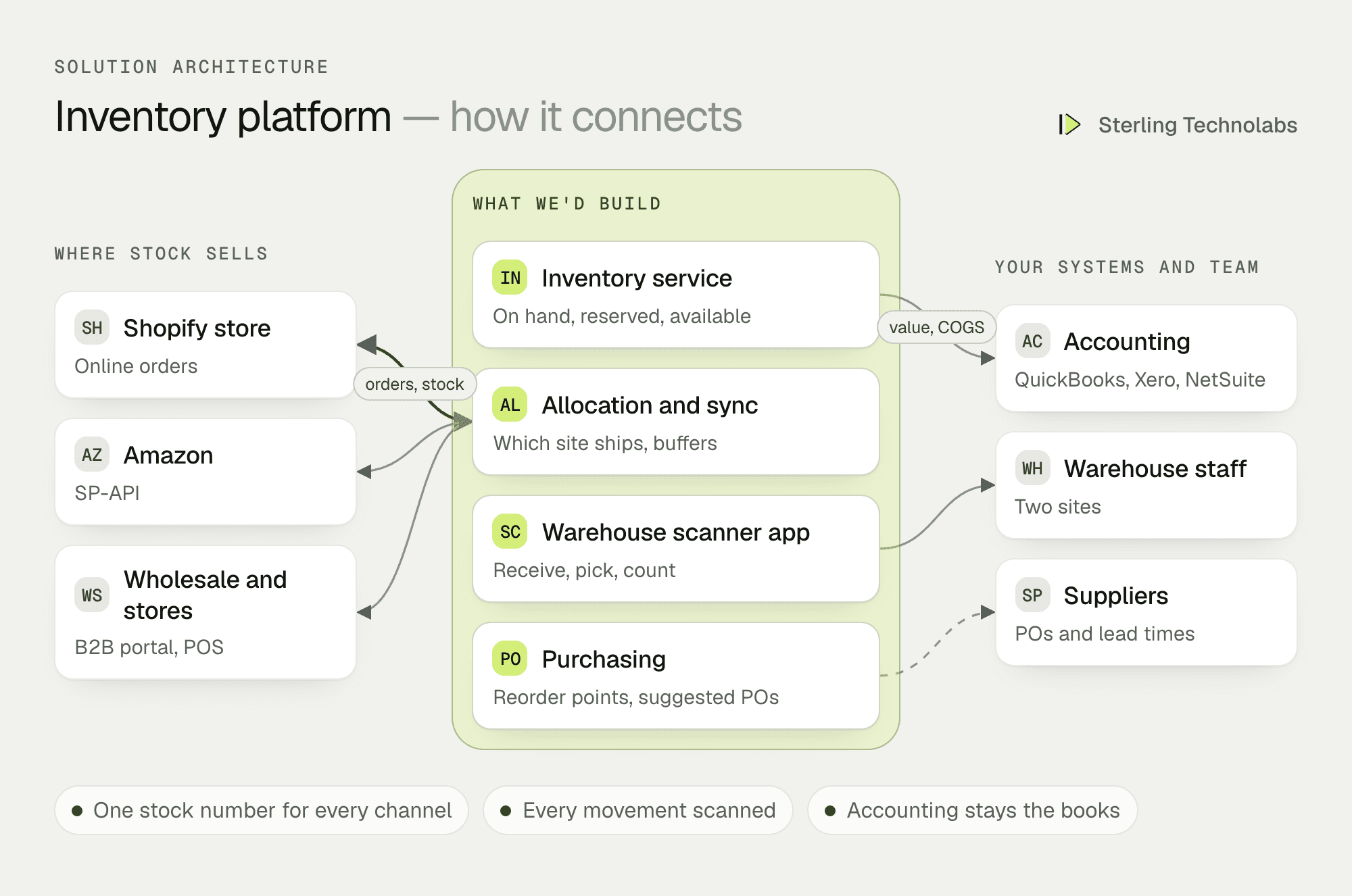
- A central inventory service holding stock for every SKU at every location: on hand, reserved, available, inbound and damaged.
- Channel sync that pushes available stock to Shopify, Amazon and the wholesale portal within minutes, with safety buffers per channel.
- A warehouse app on handheld scanners and phones for receiving against purchase orders, putaway, picking, packing, transfers and cycle counts.
- Order allocation that reserves stock as orders arrive and decides which warehouse ships, based on stock and distance.
- Purchasing and reorder points calculated from sales velocity, lead times and seasonality, with suggested purchase orders for buyers to approve.
- Bundles and kits, so a tent-and-footprint bundle sells only when both items are available.
- Accounting integration for inventory value, receipts and cost of goods sold.
How the pieces fit
One stock number, many channels
Channels stop holding their own stock counts. The inventory service is the single source, and each channel gets an available quantity after reservations and a buffer. When the last unit sells on Amazon, Shopify shows it sold out within minutes. Wholesale orders reserve stock as soon as they're entered, not when they ship.
Scanning instead of paper
Every movement in the warehouse is a scan: receiving against a purchase order, putaway to a bin, picking against an order, transfer between warehouses, a cycle count. That is what keeps the numbers right after go-live. Bins are labelled, and the app tells pickers where to go in a sensible order.
Purchasing from real demand
Reorder points are calculated per SKU from recent sales across all channels, supplier lead times and seasonal patterns. Buyers see suggested purchase orders each week, adjust them and send them to suppliers. Open POs show as inbound stock, so wholesale can sell what's arriving next month.
Accounting stays the books
QuickBooks, Xero or NetSuite remains the record for financials. Receipts, inventory value and cost of goods sold are posted to it daily, so finance stops reconciling spreadsheets at month-end.
One order, end to end
Here is a holiday-sale order for the last two units of a popular tent, as it moves from Shopify to a shipped box.

The last units were reserved the moment they sold, every channel updated within minutes, and the reorder was suggested before the shelf was empty.
What the warehouse and buyers would see
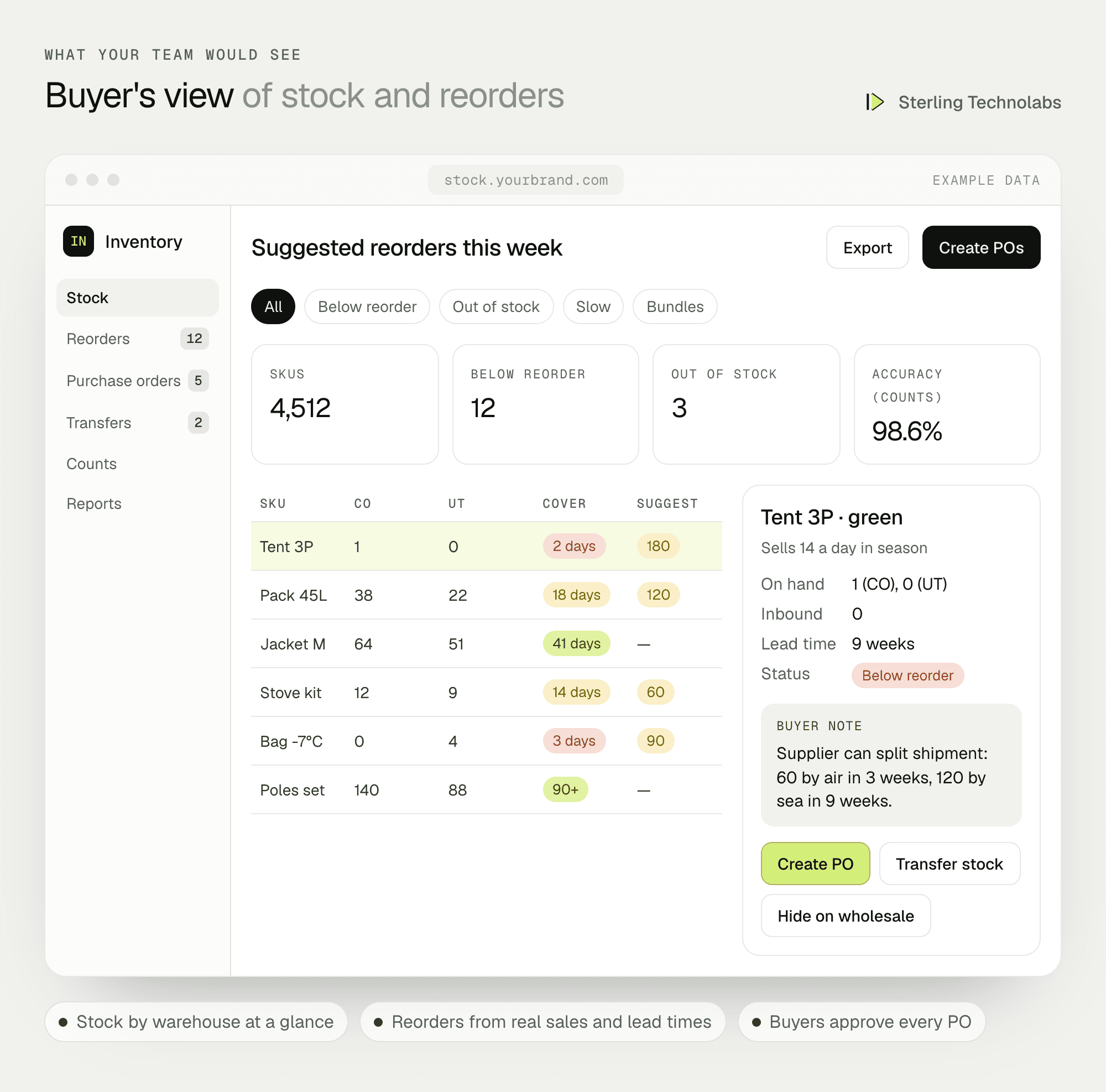
Buyers see stock, sales velocity, days of cover and suggested reorders per SKU. Warehouse staff see today's receiving, picking and counts on their scanners.
Custom inventory software features by user
| Warehouse team | Buyers and planners | Sales and ecommerce |
|---|---|---|
| Receiving against POs | Stock and days of cover by SKU | One available number per channel |
| Putaway and picking by bin | Suggested reorders | No overselling |
| Transfers between sites | Supplier lead times | Inbound stock for wholesale |
| Cycle counts on a scanner | Dead and slow stock reports | Bundles that check every part |
Data and integrations
| Integration | What it's for | Example options |
|---|---|---|
| Ecommerce | Orders in, available stock out | Shopify Admin API |
| Marketplaces | Orders and stock | Amazon SP-API |
| Wholesale | B2B orders and reservations | Your B2B portal or Shopify B2B |
| Point of sale | Store sales and transfers | Shopify POS or your POS |
| Accounting | Inventory value and COGS | QuickBooks, Xero, NetSuite |
| Shipping | Labels and tracking | ShipStation or carrier APIs |
Delivery plan
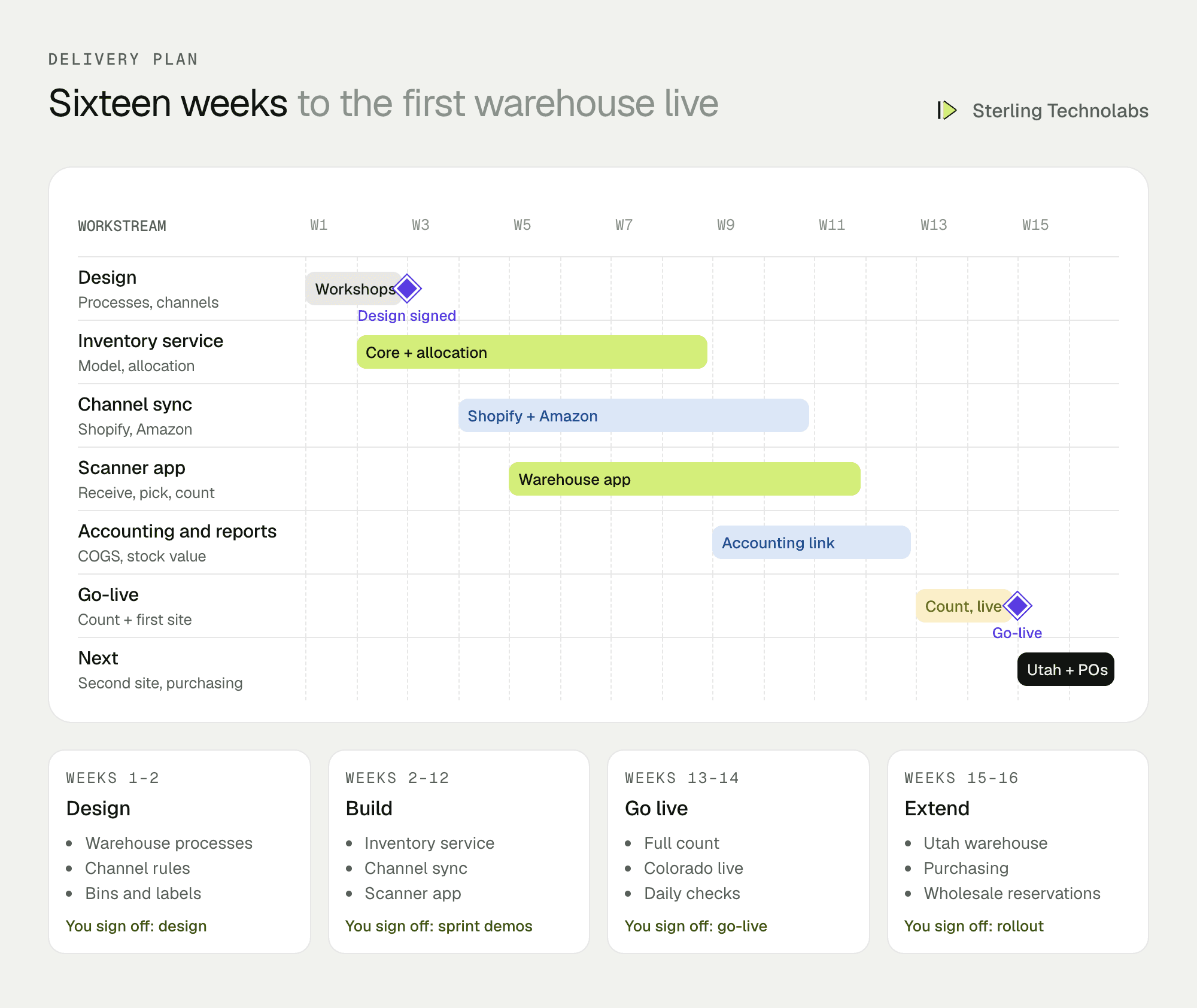
We'd start with the inventory service, Shopify and Amazon sync, and the warehouse app for one warehouse. A full count sets the starting numbers on go-live weekend. The second warehouse, purchasing and wholesale follow once the first site's counts hold steady for a month.
The team
| Role | Time | What they own |
|---|---|---|
| Solution architect | Part time | Inventory model, integrations, performance |
| Business analyst | Weeks 1–14 | Warehouse processes, channel rules, UAT |
| Back-end developers (2) | Full time | Inventory service, allocation, channel sync |
| Mobile developer | Full time | Scanner app for warehouse staff |
| Front-end developer | From week 4 | Buyer and admin screens, reports |
| QA engineer | From week 6 | Sync tests, scanner tests, go-live count |
From your side: an operations lead, a warehouse supervisor, a buyer, your ecommerce manager and your accountant.
What changes the effort
- Channels. Each channel adds an integration and its own rules.
- Warehouses. More sites mean transfers, allocation rules and more go-live counts.
- Lots and serials. Tracking batches, expiry dates or serial numbers adds data and scanning steps.
- 3PLs. Stock held at a third-party warehouse needs its API or file feed.
- Manufacturing. Kitting is simple; bills of materials and work orders are a bigger step.
Risks and how we'd handle them
| Risk | What we'd do |
|---|---|
| Wrong starting numbers | Full count at go-live, then cycle counts every week by velocity. |
| Channel sync failures | Retries, alerts and a safety buffer per channel so a delay doesn't cause overselling. |
| Warehouse staff skip scans | Fast scanning flows, no paper fallback, and daily variance reports by bin. |
| Peak-season load | Load tests at several times last Black Friday's order rate. |
| Accounting mismatch | Daily posting with a reconciliation report finance signs off during the first month. |
What we'd measure
| Metric | How we'd measure it | Baseline from |
|---|---|---|
| Oversold orders | Orders cancelled for no stock | Shopify and Amazon reports |
| Inventory accuracy | Cycle count matches by bin | Last full count |
| Stockouts | Days top SKUs are out of stock | Sales history |
| Days of cover | Stock on hand divided by daily sales | Spreadsheets |
| Order to ship time | Order placed to label printed | Shipping tool |
Build or buy?
Inventory apps and warehouse management systems cover most single-channel businesses well, and we'd point you to one if that's you. Custom inventory management software makes sense when you sell across ecommerce, marketplaces, wholesale and stores with different rules, when bundles, allocation or purchasing don't fit the products, or when per-order fees grow with volume. Many brands start with a custom inventory core and keep their existing storefronts and accounting.
Questions we'd ask on the first call
- Which channels and locations hold or sell stock?
- How many SKUs, orders a day and warehouses?
- How do receiving, picking and counts work today?
- How do you decide what to reorder and when?
- Which accounting and shipping tools do you use?
FAQ
How do you build an inventory management system?
Start with one source of truth for stock by SKU and location, record every movement with a scan, sync available stock to each channel, and connect purchasing and accounting. This blueprint shows that sequence.
What does custom inventory management software cost?
It depends mostly on channels, warehouses and how much purchasing and reporting you need. We give a written estimate after the first call, with a smaller first release as an option.
Can it stop overselling on Shopify and Amazon?
Yes. Both read available stock from one inventory service, with reservations and safety buffers, and update within minutes of each sale.
Does it replace our accounting system?
No. Accounting stays the record for financials; inventory value and cost of goods sold are posted to it daily.
:: Typical stack
Node.js, PostgreSQL, Shopify Admin API, Amazon SP-API, scanner app (Flutter), QuickBooks, Xero or NetSuite
:: Related service
Ecommerce development
See the service

Send us your brief. We’ll help turn it into reality
A senior engineer replies within one business day with questions or a first plan: approach, team, timeline and estimate.
More blueprints like this


