AI chatbot for a real estate brokerage
Real estate leads go cold while they wait for an agent. This is how we'd build an AI chatbot that answers listing questions from MLS data, qualifies buyers and sellers day and night, books showings and hands every lead to the right agent.
Industry
Residential real estate
Typical timeline
8–10 weeks
Typical team
4 people

The situation
Picture a residential real estate brokerage in the Tampa Bay area with 350 agents across six offices. Its website and listing portals bring in about 9,000 enquiries a month from buyers, sellers and renters. Four in ten arrive in the evening or at weekends, and a growing share come in Spanish.
Most enquiries are web forms that land in the CRM and wait for an agent. Response times range from a few minutes to the next day. Many questions are simple: is it still available, what is the HOA fee, when can I see it. Agents spend hours answering them, while the buyers who are ready to move often book with whichever agent replied first. The brokerage tried a scripted chatbot a few years ago; it could only follow fixed menus, gave wrong answers about listings, and visitors closed it.
The brokerage wants an AI chatbot for real estate that answers listing questions correctly from MLS data, qualifies buyers and sellers in a natural conversation, books showings, and hands every lead to the right agent with a clear summary, without stepping into advice or fair housing problems.
Signs this blueprint fits you
- You get thousands of website and portal enquiries a month.
- Many leads arrive after hours and wait until the next day.
- Agents spend time answering the same listing questions.
- Lead routing to agents is slow or uneven.
- You've tried a scripted chatbot and visitors didn't use it.
What we'd build
- A chatbot on your website, and later by text message and WhatsApp, in English and Spanish, available day and night.
- Listing answers from MLS data: price, status, HOA fees, taxes, square footage, schools listed on the MLS record and open houses, refreshed from your IDX feed every 15 minutes. The chatbot only answers from that data and says when it doesn't know.
- Qualification: buying, selling or renting, areas, budget, timeline, financing and whether they already work with an agent, asked naturally, not as a form.
- Routing and hand-off to agents by area, language, lead type and your round-robin rules, with a summary of the conversation in the CRM.
- Showing and appointment booking into agent calendars, with confirmations and reminders by text.
- Seller enquiries captured with the address and timeline, booked for a valuation call with a listing agent.
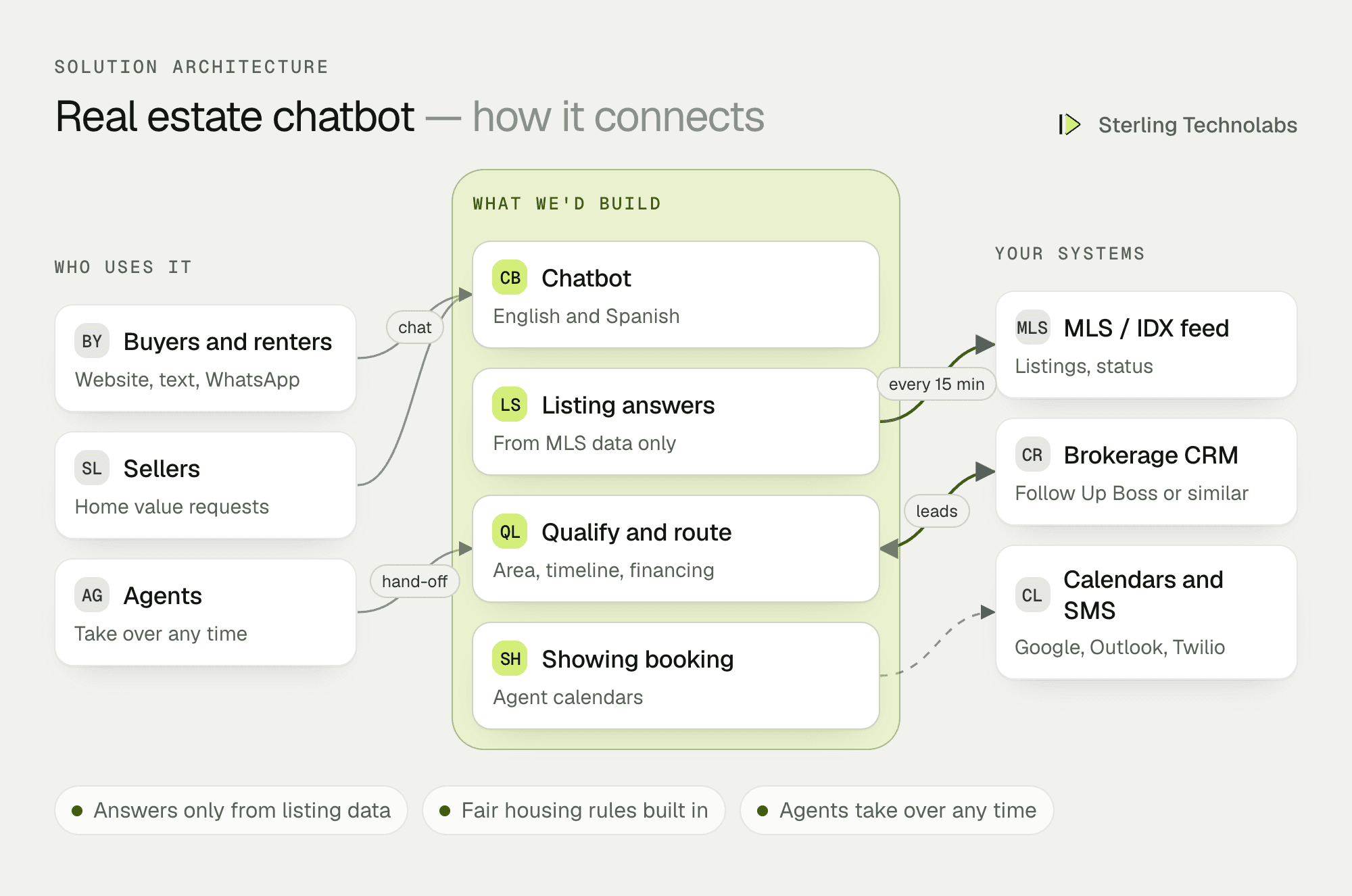
How the pieces fit
Answers come from your listing data
The chatbot uses a language model for conversation, but facts come only from your MLS feed and your own pages: listing details, office hours, your buyer and seller guides. If a question isn't covered, such as whether a specific HOA allows a large dog, it says so and passes the question to the agent. That is what keeps answers correct, and what makes agents willing to trust it.
Fair housing and advice rules built in
The chatbot is designed around fair housing rules. It doesn't describe neighbourhoods by who lives there, doesn't steer anyone toward or away from areas, and points school and crime questions to official sources. It doesn't give legal, tax or lending advice, and anything about offers, negotiation or contracts goes straight to an agent. Your compliance or legal team reviews the rules and the test conversations before launch.
Leads land in the CRM ready to work
Every conversation creates or updates a lead in your CRM, such as Follow Up Boss, kvCORE or Lofty, with the answers to the qualifying questions, the listings viewed, any booked showing and open questions. Agents see a short summary instead of a transcript. Consent to text is recorded before any text message is sent.
Agents can take over any time
Lead managers see live conversations and can step in. Agents get notified when a lead asks for a person, mentions an offer, or is ready to see a home this week. The chatbot handles the first few minutes; agents handle the relationship.
One buyer, end to end
Here is a buyer looking at a three-bedroom listing late on a weeknight.
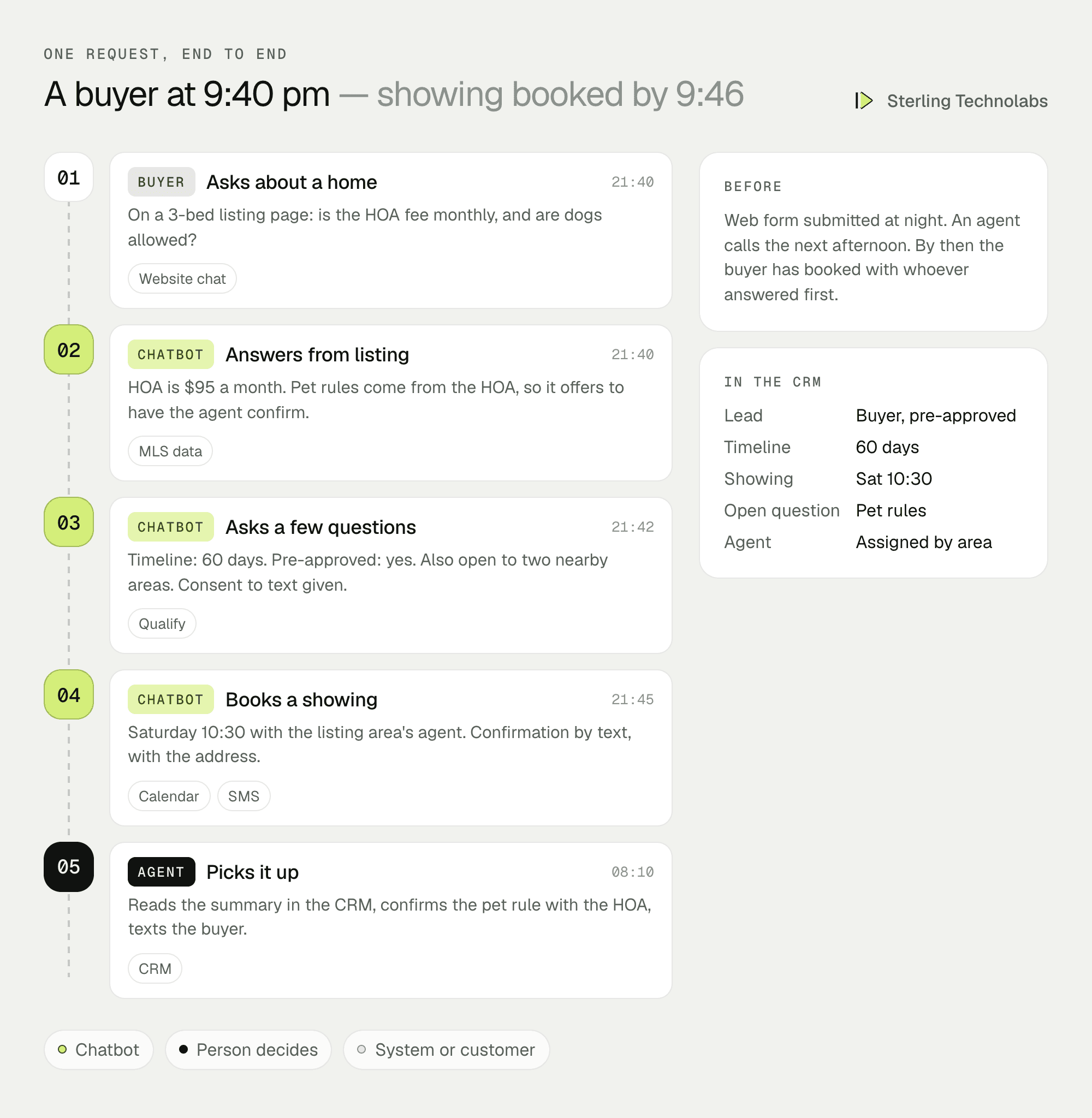
The buyer had a confirmed showing six minutes after asking, and the agent started the next morning with everything they needed to know.
What the lead manager would see
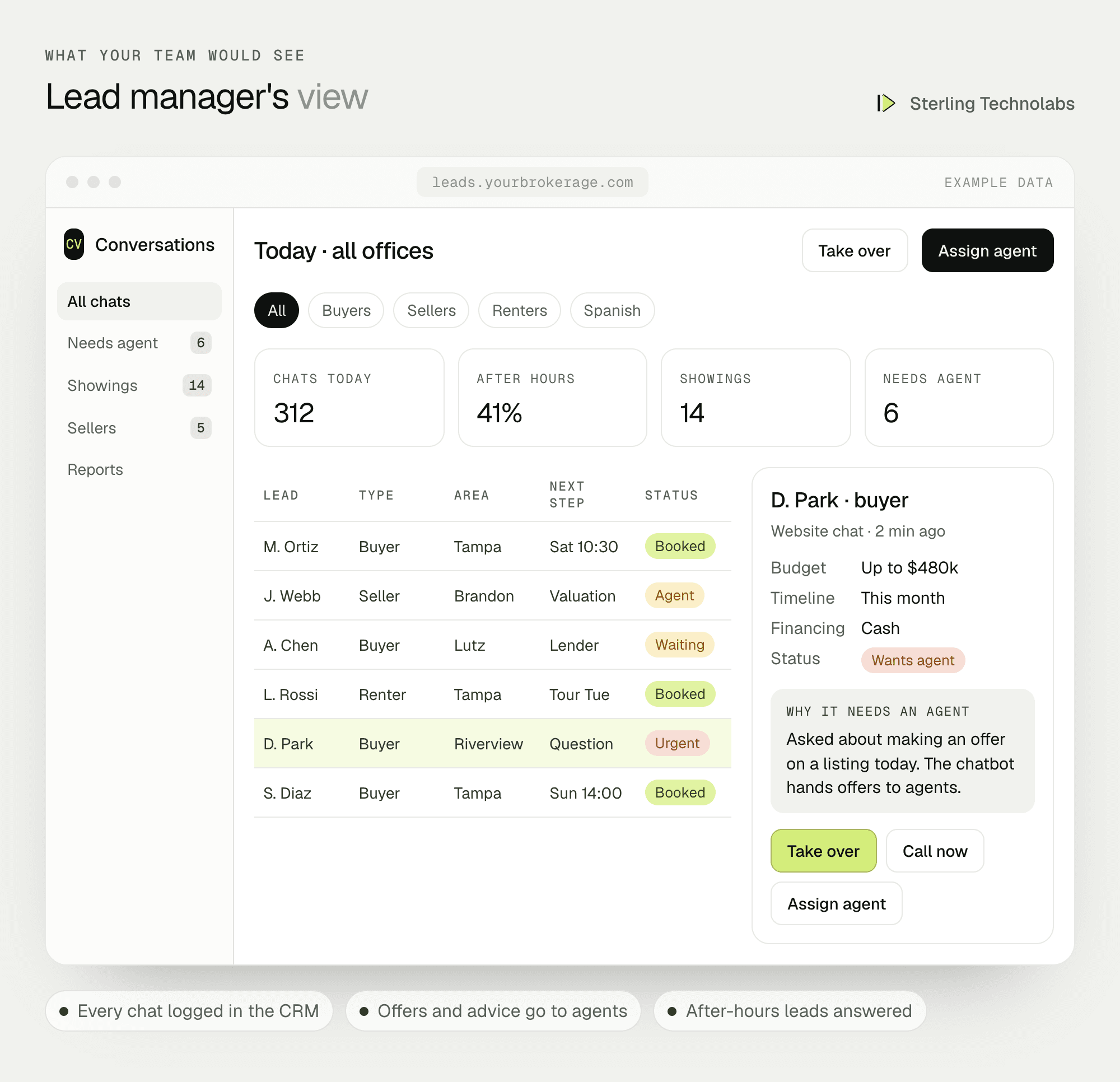
Lead managers see every conversation, which ones need an agent now, and booked showings. Agents see their own leads in the CRM they already use.
Real estate chatbot features by user
| Buyers, sellers and renters | Agents | Brokerage managers |
|---|---|---|
| Answers about any listing, any time | Leads with a short summary | Response times and after-hours volume |
| Showings booked in the chat | Showings in their calendar | Routing rules by area and language |
| English and Spanish | Alerts when a lead is ready | Conversation reviews |
| A person when they ask for one | Take over any conversation | Leads to showings to contracts |
Data and integrations
| Integration | What it's for | Example options |
|---|---|---|
| MLS / IDX feed | Listing details and status | Your MLS's RESO Web API or IDX provider |
| Brokerage CRM | Leads, notes, assignment | Follow Up Boss, kvCORE, Lofty |
| Calendars | Showings and valuation calls | Google Calendar, Outlook |
| Messaging | Text and WhatsApp conversations | Twilio, WhatsApp Business |
| Language model | Conversation, with facts from your data | Enterprise API with no training on your data |
| Website | Chat widget and listing pages | Your site or IDX pages |
Delivery plan

We'd launch on the website first, where most leads start, and review conversations with lead managers every week. Text and WhatsApp follow once the website pilot is running well, then seller valuation flows and chat on listing ads.
The team
| Role | Time | What they own |
|---|---|---|
| Solution architect | Part time | Architecture, MLS and CRM links, security |
| AI engineer | Full time | Conversation design, guardrails, testing |
| Full-stack developer | Full time | Chat widget, listing data, CRM and calendar links |
| QA engineer | Weeks 5–10 | Test conversations, fair housing checks, pilot support |
From your side: a lead manager, two or three agents to test conversations, your CRM admin, and someone from compliance or legal.
What changes the effort
- MLS access. A modern RESO Web API feed is quicker than older IDX files.
- Channels. Website chat first; text, WhatsApp and social messages each add work.
- Routing rules. Simple round-robin is quick; teams, ponds and lead scoring take longer.
- Languages. Each language needs its own testing.
- CRM. Some CRMs have open APIs; others need a partner integration.
Risks and how we'd handle them
| Risk | What we'd do |
|---|---|
| Wrong listing information | Answers only from the MLS feed, refreshed every 15 minutes, with "I'll check with the agent" when data is missing. |
| Fair housing violations | Rules and refusals built in, a test set of risky questions, and compliance sign-off before launch. |
| Text messaging without consent | Consent captured and logged in the chat before any text is sent. |
| Agents ignore chatbot leads | Short summaries in the CRM, alerts only for ready leads, and response reports by agent. |
| Visitors want a person | A person is always one message away, with a callback booked if nobody is free. |
What we'd measure
| Metric | How we'd measure it | Baseline from |
|---|---|---|
| First response time | Minutes from enquiry to first reply | CRM lead history |
| Showings booked | Showings booked from chat each week | Agent calendars |
| Lead to appointment rate | Leads that book a showing or call | CRM reports |
| Agent time on repeat questions | Hours a week, sampled from agents | Agent survey |
| Hand-off quality | Agent rating of chatbot summaries | Pilot feedback |
Build or buy?
Several real estate chatbot products plug into common CRMs, and for a small team they are usually the quickest option. A custom AI chatbot makes sense for brokerages that want answers drawn only from their own MLS feed and content, their own routing rules and languages, control over fair housing guardrails, and conversation data that stays theirs. Some brokerages start with a product and move to a custom build when they outgrow it.
Questions we'd ask on the first call
- How many enquiries a month, from which sources, and how many after hours?
- Which MLS and CRM do you use?
- How are leads routed to agents today?
- Which languages do your clients use?
- Who reviews marketing for fair housing compliance today?
FAQ
What can an AI chatbot for real estate do?
Answer listing questions, qualify buyers, sellers and renters, book showings and valuation calls, and pass every lead to the right agent with a summary, day and night.
Will a real estate chatbot give wrong listing information?
Not if it is built to answer only from your MLS feed and to say when it doesn't know. That is the core of this design.
How does the chatbot handle fair housing?
It doesn't describe areas by who lives there or steer anyone, points school and crime questions to official sources, and hands offers and advice to agents. Your compliance team signs off before launch.
How long does it take to build a real estate chatbot?
A website pilot with MLS answers, qualification, CRM hand-off and showing booking typically takes 8 to 10 weeks.
:: Typical stack
Language model via enterprise API, MLS / IDX feed (RESO Web API), Follow Up Boss or kvCORE API, Twilio, Google or Outlook calendars, Node.js
:: Related service
AI chatbot development
See the service

Send us your brief. We’ll help turn it into reality
A senior engineer replies within one business day with questions or a first plan: approach, team, timeline and estimate.
More blueprints like this


